Crew-12 Cats Prepare for Earth, Demand Gravity Be Rechecked
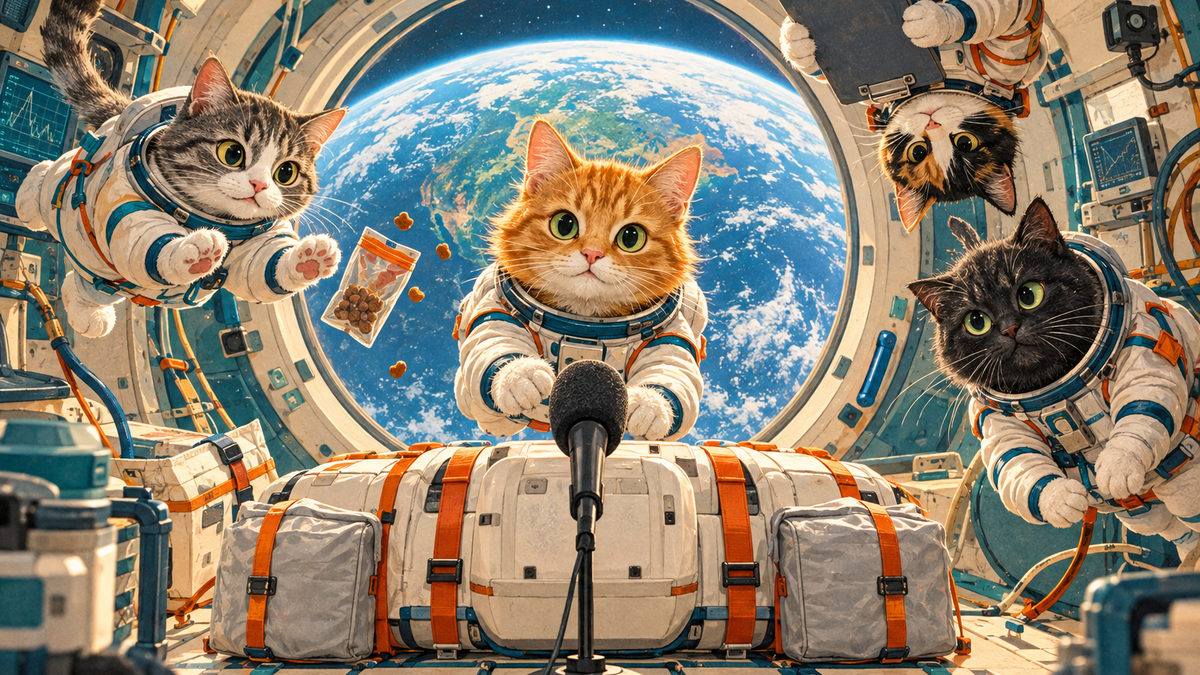
Four orbital cats brief the world on science, splashdown weather, and the stubborn return of gravity—in satire inspired by Crew-12’s upcoming journey home.
Satire: This is a fictional cat-world parody inspired by real spaceflight news. The feline characters, quotes, and events are invented.
The Orbital Feline Station has called its most important press conference of the mission: four astronaut cats are preparing to come home, and someone must explain why the return capsule contains three scientific samples, two flight suits, and approximately nine hundred unauthorized treat wrappers.
Commander Whisker Meir opened the briefing while drifting past the microphone for the second time. “Our mission has advanced the frontiers of knowledge,” she said, making a dignified attempt to stop herself with one paw. “We have studied fluids, circulation, bacteria, and the exact speed at which a crunchy snack escapes when released near an air vent.”
The crew’s departure cannot happen immediately. First, the incoming cats must arrive for a short handover: where the switches are, which cupboard contains emergency supplies, and why the station’s red laser pointer is classified as both exercise equipment and a threat to operational focus.
Flight engineer Sophie Pawdenot said the handover document had grown to 412 pages after the crew added a new section titled “Objects That Look Stationary But Are Not.” The list reportedly includes pens, dinner, sleeping cats, and one extremely patient blob of water.
Andrey Fedyapaw, meanwhile, chaired the Return Readiness Committee from inside a cardboard box marked FLIGHT HARDWARE. The box was not on the official manifest, but mission control admitted that removing him would create more paperwork than allowing it to proceed to Earth.
Before departure, teams will check conditions near the splashdown zone. The cats strongly support this policy. They have spent months surrounded by carefully managed water droplets and consider “an entire ocean” an unnecessarily ambitious amount of liquid.
“We respect the sea,” said Jack Hathawhay, tightening his harness. “From a capsule.”
The crew also rehearsed the difficult transition back to gravity. In orbit, a cat can push gently from a wall and cross a room with the elegance of a tiny comet. On Earth, the same maneuver is known as jumping off the sofa, and management may object if performed during a televised debrief.
Scientists expect the returning explorers to need time to readapt. The cats expect Earth to need time to readapt to them. A rehabilitation plan includes balance training, medical checks, and several supervised sessions of knocking objects off tables to confirm that gravity remains operational.
At the end of the briefing, Commander Meir thanked the international teams supporting the mission and promised a disciplined return. Then a treat pouch floated into view, all four crew members abandoned formation, and the broadcast switched to a tasteful image of Earth.
The real news behind the joke
NASA scheduled a news conference from the International Space Station for 2:45 p.m. EDT on September 16, 2026. Crew-12 members Jessica Meir and Jack Hathaway of NASA, Sophie Adenot of ESA, and Andrey Fedyaev of Roscosmos are due to discuss their mission and upcoming return to Earth.
The crew launched on February 13, 2026 and worked with Expedition 74/75. NASA says Crew-12 contributed to hundreds of experiments, including research involving pneumonia-causing bacteria, on-demand intravenous fluid generation for future missions, and how physical characteristics may affect blood flow during spaceflight. Their departure is planned after Crew-13 arrives and a short handover is completed. Mission teams will review weather at splashdown sites off California before the crew leaves the station.
NASA’s human-research overview also describes studies of how astronauts adapt to altered gravity and how researchers assess landing-related risks after return. Those details matter for future long-duration missions, even if no laser pointers are involved.
Sources
- NASA: Crew-12 to discuss station mission and upcoming return (updated September 11, 2026)
- NASA: Crew-12 research on adaptation to altered gravity
- NASA International Space Station blog
Illustration disclosure: The feature image was generated with AI for this fictional feline satire and does not depict the real Crew-12 astronauts.