Space Cats Double a Telescope’s Life by Driving Properly
A precision burn leaves NASA’s Roman telescope with fuel for at least 22 years—and sends the feline space bureaucracy into orbit.
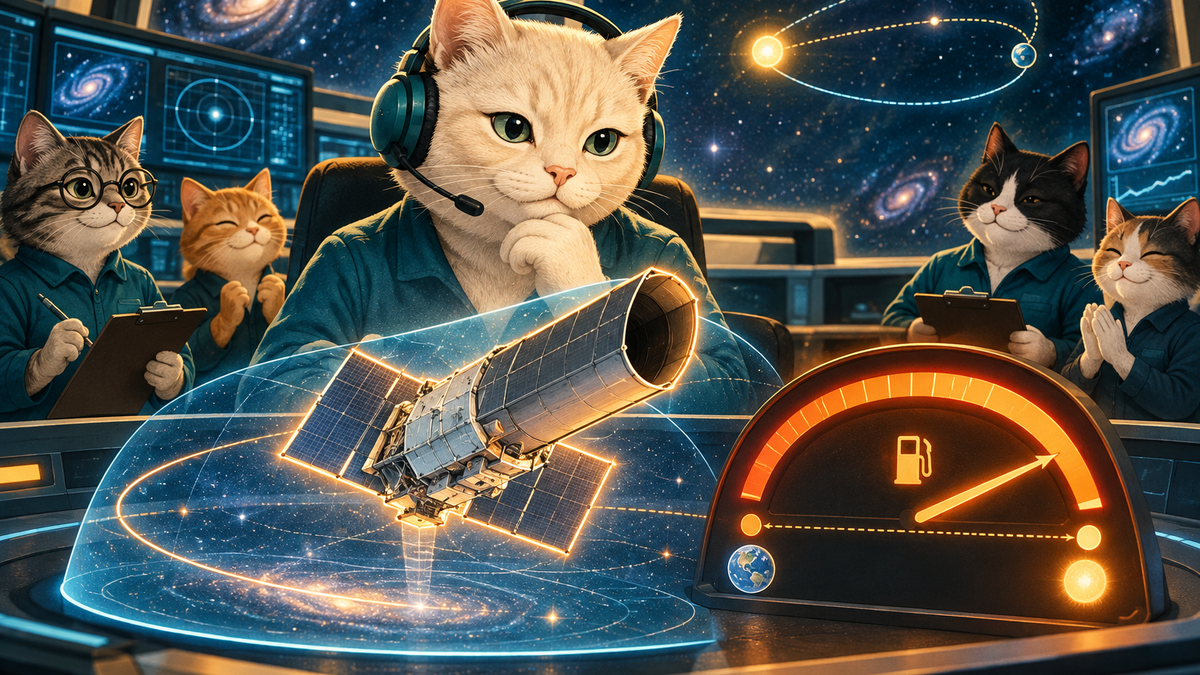
Cat parody / satire. The feline officials and events below are fictional. The factual news that inspired them appears separately at the end.
Space Cats Discover the Cheapest Way to Double a Mission: Drive Properly
The Interstellar Council of Responsible Zoomies announced Friday that its newest telescope may remain operational for 22 years after the spacecraft completed one maneuver without knocking over a glass, shredding a curtain, or sprinting sideways into a wall.
The observatory, Lady Roman of the Extremely Wide Window, had been provisioned for ten years of cosmic surveillance. Its official duties include counting galaxies, inspecting dark matter, and determining whether the universe contains a red dot that no paw can ever quite catch.
Mission director Dr. Miso Whiskerburn called the result “an unprecedented triumph of not wasting dinner.” According to Whiskerburn, engineers had set aside a large bowl of propellant for the first course correction. The telescope used only a dainty lick.
“We planned for the maneuver as if a kitten were driving,” she explained, standing beside a fuel gauge now marked with several additional nap cycles. “Instead, the burn was more than 99 percent accurate. Nobody oversteered. Nobody attacked the trajectory cursor. Frankly, we are reviewing whether the spacecraft is actually a cat.”
The news caused immediate confusion in the Council’s finance department, where administrators had already prepared a ten-year supply of forms explaining why the mission needed more forms. A hastily convened committee proposed spending the saved fuel on a larger committee, but propulsion specialists placed the suggestion inside a sealed cardboard box.
Roman’s unexpected thrift came from several sources. The spacecraft launched lighter than the cautious planning limit, so its tanks could carry extra propellant. Its first correction also consumed far less than budgeted. Future maneuvers are now expected to be gentler, provided no asteroid rolls under the sofa at the critical moment.
At mission control, scientist cats celebrated in the traditional manner: one slow blink, two spreadsheets, and a nap directly on the warmest keyboard. The public-relations office briefly considered the slogan “Same Telescope, More Universe,” before remembering that slogans require meetings.
The spacecraft is traveling toward a position near Sun–Earth L2, a gravitationally convenient neighborhood roughly one million miles from Earth. Feline navigators describe it as “the sunny windowsill of deep space, except technically complicated and with no actual sill.” Once settled, the observatory will make small station-keeping burns about every 28 days—roughly the same interval at which a house cat decides an unchanged room must be re-examined from every angle.
Officials cautioned that available fuel is not the same as a guaranteed operating calendar. Future funding, hardware health, and scientific priorities still matter. Nevertheless, the Council has already penciled in a 2048 retirement banquet featuring freeze-dried salmon and a laser pointer aimed responsibly away from flight hardware.
Dr. Whiskerburn ended the briefing with a lesson for kittens everywhere: “Accuracy preserves resources. Planning creates options. And if you can reach your destination using less fuel, never tell the cat who controls the treat budget until the savings are safely documented.”
The real news behind the joke
NASA said on September 14 that the Nancy Grace Roman Space Telescope has enough fuel for at least 22 years of potential science operations, more than double its original 10-year fuel budget. Roman’s August 31 mid-course correction was executed with more than 99% accuracy and used about 40 pounds (18 kilograms) of propellant—less than 10% of the 441 pounds (200 kilograms) allocated. The spacecraft also launched lighter than the conservative planning mass, allowing its tanks to carry extra fuel. NASA expects further savings from the next correction and orbital insertion before Roman settles near Sun–Earth L2. The 22-year figure describes fuel potential, not a guaranteed funded mission duration.
Sources
- NASA Science — “Fuel Savings Double Potential Lifetime for NASA’s Roman Mission” (September 14, 2026)
- ScienceDaily — “NASA’s Roman Space Telescope could last more than twice as long as planned” (September 18, 2026)
- Reuters — “NASA says new Roman telescope’s lifespan could more than double, to 22 years” (September 17, 2026)
Illustration disclosure: The feature image is AI-generated editorial artwork depicting a fictional feline mission-control scene.