Earth Hires a Cat to Audit the Solar Wind
A joint European-Chinese spacecraft starts watching Earth’s magnetic shield, so naturally a cat demands the solar wind’s paperwork.
Cat parody / satire: The newsroom, characters and dialogue below are fictional. The space mission in the factual section is real.
LOW EARTH ORBIT — After several billion years of accepting solar wind without reading the terms and conditions, Earth has appointed a cat to conduct a full audit of incoming space weather.
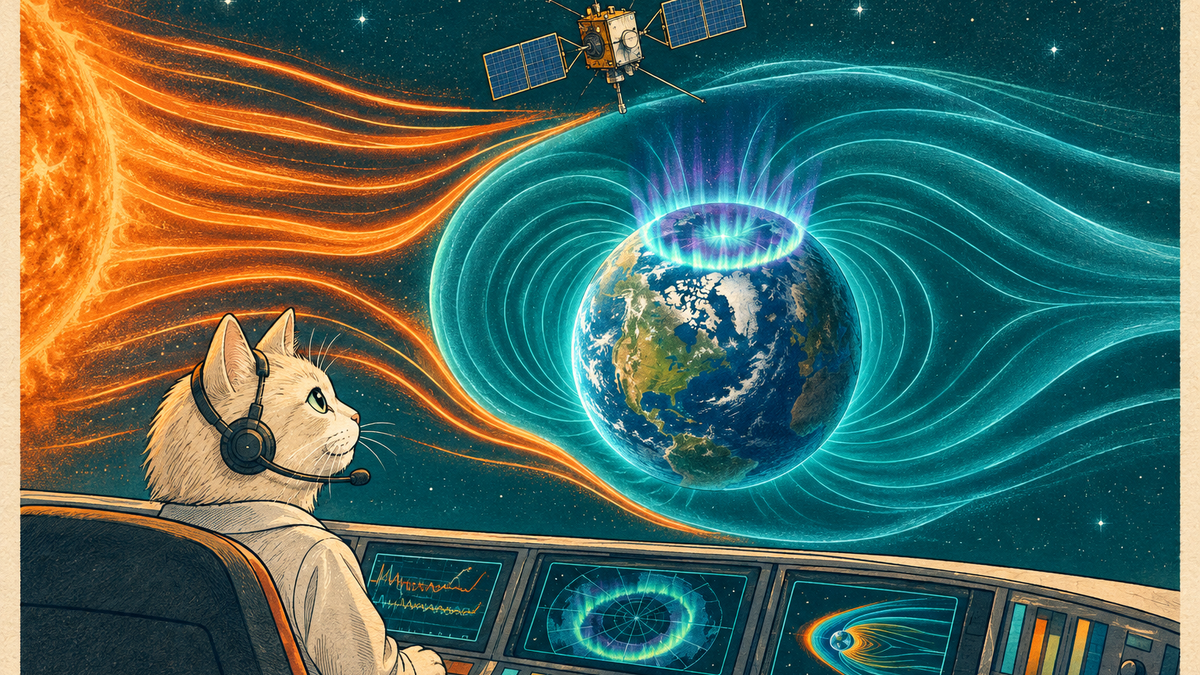
Commander Miso, newly installed at the Planetary Reception Desk, said the investigation began when an orange ribbon of charged particles arrived from the Sun without an appointment.
“It was moving quickly, glowing suspiciously, and touching the magnetic field,” Miso told reporters while sitting on the only button marked DO NOT SIT HERE. “Naturally, I stared at it for forty-five consecutive hours.”
The audit is being assisted by Smile, a European-Chinese spacecraft carrying four scientific instruments. In the feline version of mission control, these have been renamed the Long-Distance Glare, the Invisible-Thing Detector, the Whisker Compass and the Sniffing Box. Human scientists continue to use the less memorable names SXI, UVI, MAG and LIA.
Early observations suggest Earth’s magnetosphere behaves much like a very large cardboard box: it looks simple from a distance, but once energetic material enters, the geometry becomes complicated and someone starts shouting about boundaries.
Miso’s first report praised the planet’s magnetic shield for bending streams of solar material around Earth. However, the report also issued three recommendations: add a second shield for redundancy, place all satellites in padded baskets, and stop calling auroras “space weather” when they are clearly the sky’s laser pointer.
The Sun declined to comment, then emitted several million tonnes of plasma in every direction.
At a joint press conference, cats from Europe and China celebrated Smile’s move into science operations by simultaneously claiming the warmest chair. Negotiations were peaceful. Both parties agreed that sharing data was easier than sharing a lap.
The spacecraft will now watch the interaction between solar wind and Earth’s magnetic environment from a highly elliptical orbit. Mission staff stressed that Smile is an acronym, not an instruction. Commander Miso nevertheless smiled briefly after learning the ultraviolet camera could watch the northern auroral ring for nearly two days at a stretch.
“That is excellent persistence,” she said. “Possibly a cat designed it.”
She then pushed a pen off the console to test local gravity. Results were immediate, repeatable and ignored by every journal reviewer in the room.
The real news behind the joke
On 30 September 2026, the European Space Agency announced that Smile — the Solar wind Magnetosphere Ionosphere Link Explorer — had been approved to begin science operations. The joint ESA–Chinese Academy of Sciences mission launched on 19 May and reached its target science orbit on 20 June before undergoing in-space commissioning.
Smile carries a soft X-ray imager, an ultraviolet imager, a magnetometer and a light ion analyser. Together they are designed to study how the solar wind interacts with Earth’s magnetosphere, how that interaction produces auroras and geomagnetic storms, and how space weather can affect satellites, navigation, communications and other electronic infrastructure.
ESA says the ultraviolet instrument is the first camera since 2008 to capture the full northern auroral ring in ultraviolet, with observations lasting up to 45 hours at a time. Beijing News, citing the Chinese Academy of Sciences, also reported on 30 September that the spacecraft had passed its in-orbit test review, entered science operations and released initial observations and data from all four payloads.
Sources: European Space Agency — Science begins for Smile (30 Sep 2026); Beijing News — Smile enters science operations (30 Sep 2026); National Space Science Center, CAS — mission background (19 May 2026).
The illustration is AI-generated and depicts a fictional feline mission controller.