Cats Open Semiconductor Cleanroom, Immediately Negotiate a Shedding Exemption
A fictional feline chip factory discovers that precision engineering is easier than persuading cats not to shed—or occupy the packaging.
Cat parody / satire. The feline newsroom below is entirely fictional. Real-world inspiration and sources appear separately at the end.
SAMUT PURRAKAN — The Kingdom of Cats has unveiled its most ambitious semiconductor initiative yet: a room in which nobody is allowed to shed.
At the fictional facility’s opening, Chief Operations Cat Marmalade described the cleanroom as “a historic opportunity to prove that advanced manufacturing and an orange employee can coexist.” Behind him, a technician quietly removed an orange hair from his presentation remote.
The plant will package and test tiny electronic components. This distinction immediately disappointed several guests, who had understood “chips” to mean something served beside a fish. Procurement confirmed that neither salt nor vinegar would be entering the production line.
“We are moving up the value chain,” Marmalade explained. “Previously, we sat on the cardboard box. Now we inspect the sophisticated thing inside it before sitting on the cardboard box.”
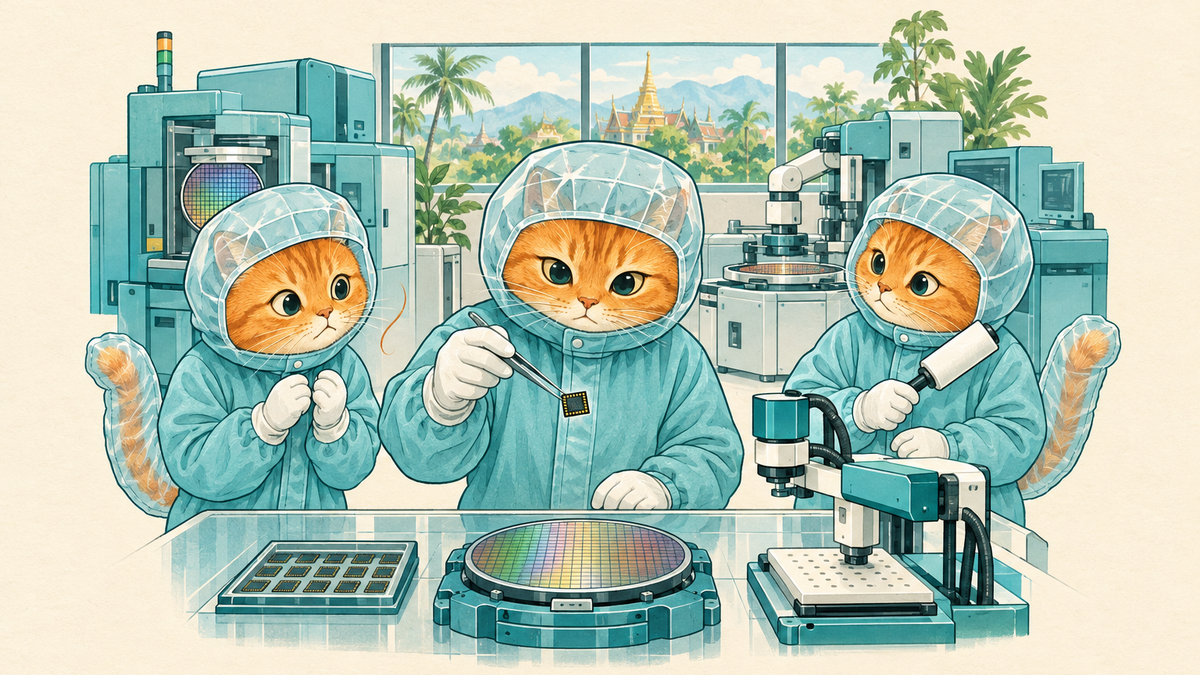
The centrepiece of the launch was a protective suit with a dedicated tail sleeve. Engineers celebrated it as a breakthrough in containment. Employees celebrated the fact that their tails looked important. One senior analyst requested a second sleeve for the tail’s deputy.
Admission procedures were unusually strict. Every cat had to pass through an air shower, surrender loose fluff and promise not to groom during a shift. The grooming restriction prompted an emergency meeting of the Committee for Things We Were About to Do Anyway.
Quality supervisor Dr. Whisker rejected suggestions that purring might improve production. “A pleasant vibration is not automatically a manufacturing process,” she said, placing a tiny component beneath a microscope. “And a microscope is not a luxury drinking bowl merely because you can see your reflection in it.”
Her team’s first inspection uncovered a particle near the workbench. Security sealed the area. Management commissioned a report. The particle was eventually identified as a hair belonging to the cat who had commissioned the report, who immediately requested an independent report.
Elsewhere, packaging specialists confronted the industry’s most difficult local problem: a perfectly good empty carton. Under the new rules, boxes must remain available for products rather than become sleeping accommodation. Staff described this policy as technically understandable but spiritually devastating.
The union proposed a compromise in which every shipment would include one designated decoy box. Management countered with a pilot programme involving a square painted on the floor. Negotiations stalled when the entire bargaining team sat inside it and refused to recognise the meeting as adjourned.
Testing also brought surprises. A prototype automatic feeder passed electrical checks but failed the feline acceptance test because it dispensed food only at the scheduled time. The product team was instructed to consider a more responsive architecture, preferably one that interpreted meaningful eye contact as an urgent service request.
By afternoon, the factory had adopted a new definition of precision: doing the same thing reliably, without first pushing it off a table. Visitors applauded. A nearby robot arm paused, apparently reconsidering its career options.
Marmalade closed the ceremony by announcing that the facility’s greatest asset was its workforce. The workforce agreed, then asked whether the cleanroom lights could be repositioned to create a warmer patch on the floor. Dr. Whisker vetoed the proposal before anyone could call it a thermal optimisation strategy.
Production preparations continued under close supervision. The chip remained on the bench. The box remained empty. For one remarkable moment, the cats considered both outcomes evidence of progress.
The real news behind the joke
Tech in Asia reports that Infineon opened a semiconductor back-end facility near Bangkok on October 1, 2026, for turning chips into finished, tested semiconductors. Separately, Infineon’s February 4, 2026 primary-source release confirms that construction of its new Samut Prakan back-end fab began in January 2025. That earlier release concerns the sale of a different Bangkok/Nonthaburi site; it is background evidence, not an announcement of the October opening. The cats, quotations, workplace rules and incidents above are invented.
Sources
- Tech in Asia: Infineon opens semiconductor facility in Thailand — fetched for its reported October 1 opening.
- Infineon: completes sale of its Bangkok/Nonthaburi manufacturing site — February 4, 2026; primary-source background on the separate Samut Prakan project.
Illustration: AI-generated fictional editorial cartoon, not a photograph of an actual factory or workers.