Cats Discover the Chip Queue Now Reaches 2030; Whisker Operations Calls Emergency Nap Meeting
A fictional feline semiconductor council faces a wafer queue stretching to 2030, inspired by ASML’s real report of surging AI-driven demand and planned capacity falling short.
CAT PARODY / SATIRE: The feline newsroom below is fictional. Real-world reporting is separated in the factual section.
VELDHOVEN, FELINE DESK — The International Council of Cats Who Understand Tiny Machines (ICCTM) convened an emergency nap meeting Wednesday after learning that orders for advanced chipmaking equipment may stretch all the way to 2029 and 2030. The council’s official response: “We were hoping to have the wafers by Thursday.”
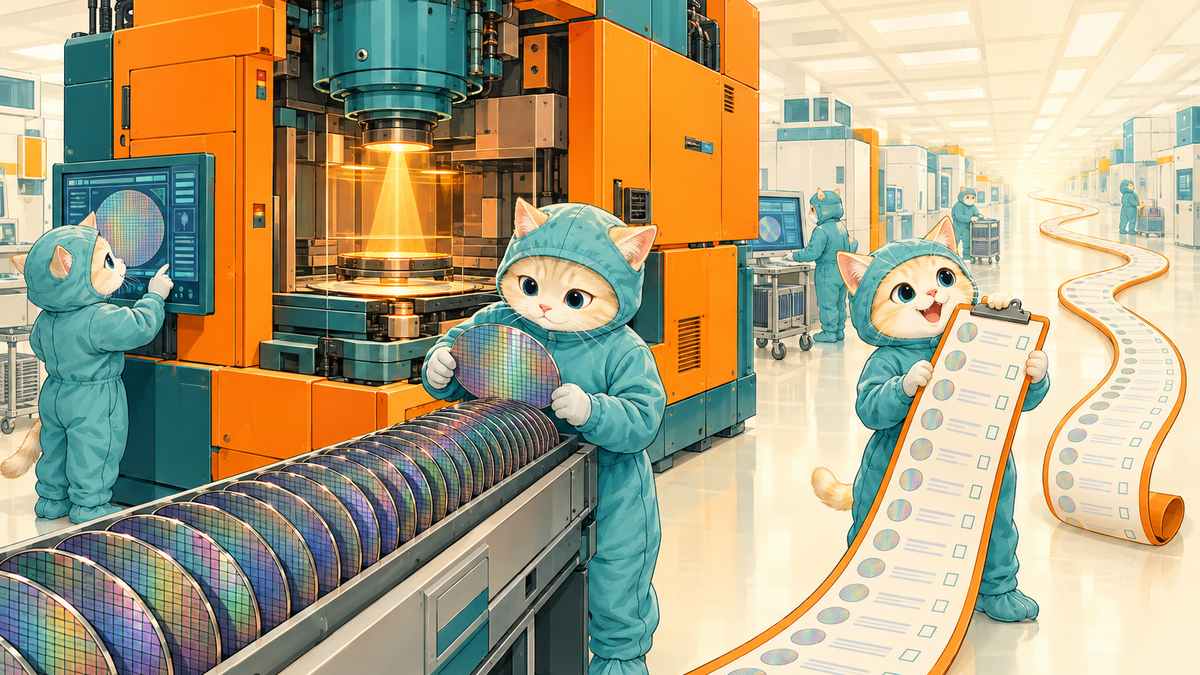
In the story’s entirely imaginary cleanroom, Chief Whisker Officer Miso unrolled a production calendar so long it crossed the room, passed the treat cupboard, and disappeared behind a large machine humming with the confidence of something that costs more than the entire neighborhood. A junior technician named Pixel followed the scroll with a paw-operated ruler. “The queue has reached the year when I might finally understand why the printer needs an update,” Pixel reported.
The cats’ predicament has a familiar shape: demand is bounding ahead, while the machines that make the machines cannot simply be summoned by shaking a box of kibble. So ICCTM appointed a Capacity Expansion Taskforce, which immediately split into two camps. The optimists proposed adding another shift. The realists proposed adding another shift and a second sunbeam in the break room.
“We can increase output,” said fictional operations director Sir Pounce, standing beside a clipboard wider than his litter tray. “But we must first determine whether the new cleanroom can accommodate the existing nap schedule.” His committee’s preliminary plan includes training more wafer-balancing cats, redesigning the corridor to prevent tail-related traffic jams, and asking customers to submit their forecasts in a format that does not involve a mysterious spreadsheet called final_FINAL_v7.
Meanwhile, the demand forecasters have been busy. Their model reportedly combines customer conversations, chip plans, and the ancient technique of staring at a sunbeam until the answer becomes obvious. It predicts strong interest in future tools, although the model’s confidence interval widens substantially whenever someone opens a can.
At the press briefing, Miso clarified that the Council does not promise a machine for every cat by next week. “We are investigating ways to expand capacity,” she said, then added, “and ways to make the queue more comfortable.” A trial lounge will offer padded chairs, quiet purring, and a clearly marked section for orders that are definitely urgent but not urgent enough to interrupt lunch.
Analysts in the fictional Catnip Markets division called the news “constructive, subject to the availability of cardboard boxes.” One analyst raised a paw to ask whether 2030 orders would require a new generation of laser pointers. The council declined to comment, citing ongoing negotiations with the red dot.
By evening, the taskforce had produced its first deliverable: a second clipboard to track the first clipboard. Progress, Miso insisted, should be measured not only in machines shipped but in tails kept out of conveyor belts. The cats adjourned for a short rest, scheduled to last until someone rustled a snack bag.
The real news behind the joke
ASML reported third-quarter 2026 net sales of €11.7 billion and net income of €5.0 billion on October 14. The chipmaking-equipment company said customers’ short- and medium-term demand forecasts had risen, driven primarily by their expectations for AI-related investment; some customers are interested in orders for 2029 and 2030. ASML said its currently planned supply for 2027 and 2028 would not fully meet customer demand, and that it is investigating ways to increase capacity. It also raised its 2026 full-year sales outlook to €44–45 billion. Reuters independently reported the same-day capacity shortfall outlook. No cats, nap committees, or red-dot negotiations were involved.
Sources
- ASML: Q3 2026 results and outlook (14 October 2026)
- Reuters: ASML’s AI demand outlook (14 October 2026)
Illustration generated with AI.