Two Towers, One Very Big Cat Brain
Two desktop towers join forces to run a powerful AI model. The Cat Council has one question: can it find the best box?
CAT PARODY / SATIRE: This is fictional humor inspired by real technology news. The cats, dialogue, and events below are invented.
In the Republic of Purrs, two rival towers have joined forces to run a very large artificial intelligence model, prompting the Cat Council to ask the urgent question: could all that computing power finally identify the best box in the room?
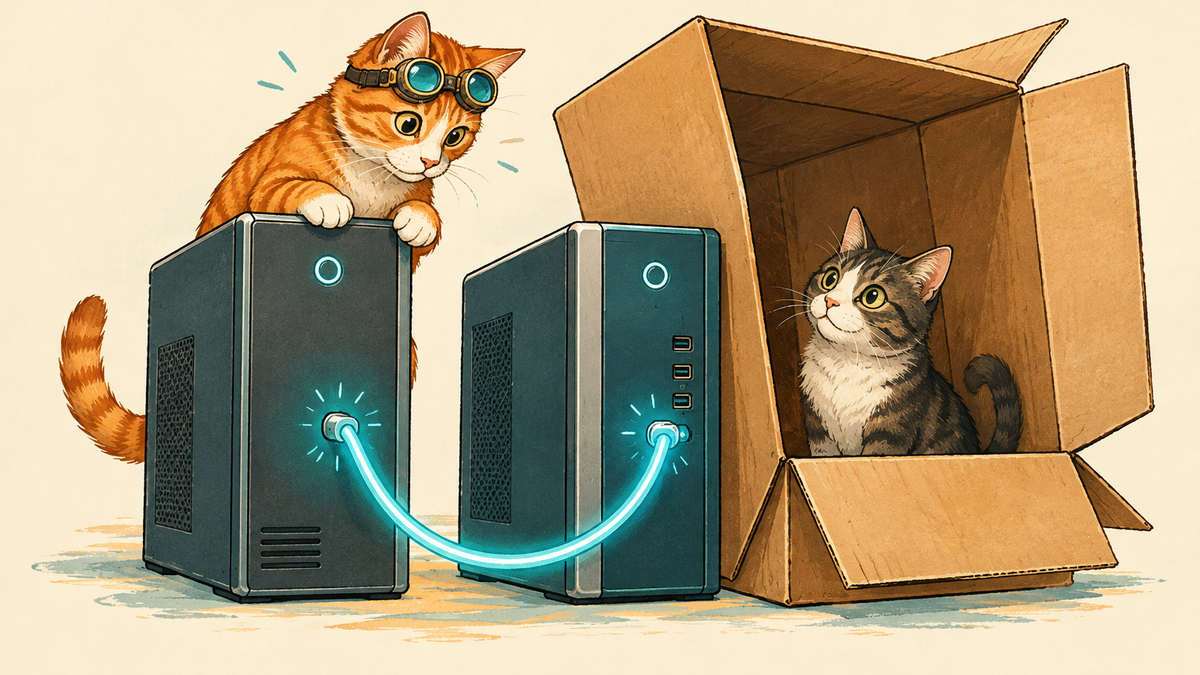
The fictional alliance began at dawn, when engineers wheeled two desktop computers into the Palace of Extremely Important Nap Spots. Each machine was polished until it reflected a small, anxious cat. A thick cable linked them together. The Council’s official diagram labeled the connection “probably not a shoelace.”
“We have combined our talents,” announced Professor Whiskerbyte, who had been assigned to guard the power strip. “One tower handles the complicated thinking. The other tower handles the complicated thinking when the first tower needs a snack.”
The model, known locally as Muse Spark Open, was given an initial benchmark: inspect a photograph containing one cardboard box, two sunbeams, and a suspiciously vacant laundry basket. It returned a concise report: “The box is structurally promising. The laundry basket may be a decoy. Recommend sitting in all three locations before reaching a conclusion.”
The Council was impressed, though the Minister of Treats objected that the answer lacked a confidence score for “box smell.” A second test asked the machine to draft a plan for a multi-step task: locate the warmest cushion, move a plush fish onto it, and reserve the cushion for a senior cat. The model produced a checklist so thorough that the senior cat fell asleep before step one.
There was, however, a small logistical wrinkle. The computers required an extravagant amount of memory and a budget large enough to make the Treasurer’s whiskers stand straight. The Council’s thrift committee proposed a more affordable alternative: four cats sitting very close together and pretending to be one distributed system. Their prototype ran beautifully until the cat at the edge spotted a moth and left the cluster.
A spokesperson for the imaginary Cat Council insisted that the project was not about replacing feline judgment. “No model can understand the sacred distinction between a box you may sit in and a box you must immediately knock off the table,” she said, while knocking a pen off the table for emphasis.
The next phase will test local inference in a real home environment, where internet access is unreliable and the user may be typing with one hand while the other hand is unavailable due to a cat. The engineers are optimistic. The cats are reserving judgment until the cooling fans are confirmed to be warm enough for supervised lounging.
By evening, the two towers had completed their demonstration. The model correctly identified the box, summarized the treat inventory, and drafted a polite request for more treats. It did not, despite repeated prompting, admit that the box belonged to the cat. The Council called this a promising start.
The press conference ended with an unprecedented demonstration of transparency: the engineers opened the case and showed the Council where the memory lived. The cats nodded solemnly, then asked whether the memory could be trained to remember which cupboard contained the good treats. The answer was not in the release notes.
The real news behind the joke
Meta announced Muse Spark Open on October 15, 2026, and says it has optimized the open-weight model for Apple Silicon using MLX. Meta describes the model as designed to run across paired Mac Studio systems. CNBC reported the Apple–Meta collaboration and the practical requirement for high-end hardware; TechCrunch also covered the model’s Mac focus. Performance and specifications attributed to Meta are company claims, not independently established here.
Sources
- Meta AI Research: Introducing Muse Spark Open (primary announcement, Oct. 15, 2026)
- CNBC: Apple and Meta team up to make Muse AI model run on Mac computers (Oct. 15, 2026)
- TechCrunch: Meta launches an open-weight AI model that runs on Macs (Oct. 15, 2026)
Illustration generated by AI.