Robot Asked to Demonstrate Recurring Revenue, Performs Another Backflip
China’s humanoid-robot IPO rush meets a saucer of reality as regulators reportedly ask whether dazzling machines can become durable businesses.
Cat parody / satire: The feline characters, dialogue and events below are fictional. The factual reporting is separated in the final section.
Robot Asked to Demonstrate Recurring Revenue, Performs Another Backflip
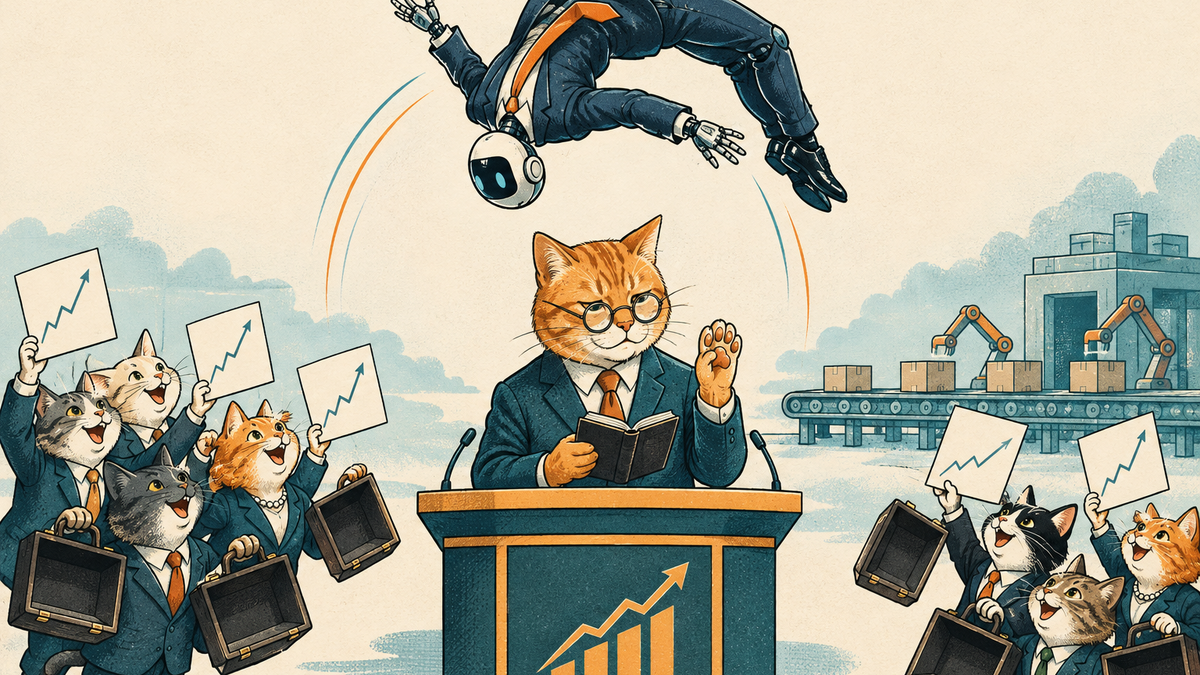
At the Shanghai Paws & Prosperity Exchange on Monday, a humanoid robot named Chairman Whiskertron attempted to answer a straightforward question about recurring revenue by executing a flawless backflip over a mahogany earnings desk.
“Impressive,” said Madam Tangerine, the orange-tabby regulator chairing the hearing. “But the question was whether customers will buy a second one.”
Whiskertron’s LED eyes flashed teal. It bowed, produced a smoke effect that had not been approved by compliance, and kicked a ceremonial gong marked only with an optimistic upward arrow.
The assembled investor cats erupted in applause. One immediately valued the gong at nine billion tins of tuna. Another raised the estimate after learning that the robot could also stand up after being gently pushed.
“You are looking at the future of labour,” declared venture capitalist Sir Leverage Mittens, whose previous investments included blockchain litter and a subscription saucer. “Today it backflips. Tomorrow it may sort socks. By 2038 it could identify which sock belongs to whom, subject to favourable battery conditions.”
Madam Tangerine adjusted her spectacles and opened a thin folder. “Your prospectus says the paws—excuse me, hands—are not yet precise or durable enough for sustained work.”
“That is an outdated interpretation,” replied the company’s chief optimism officer. “We now describe them as pre-precision hands.”
A practical factory cat named Bao raised a paw from the back row. Bao had brought three test objects: a wrench, a teacup and a cardboard box labelled “ordinary Tuesday.” Whiskertron saluted the wrench, composed a short dance for the teacup and asked the box to join its waitlist.
Sir Leverage Mittens called the demonstration “a decisive expansion into logistics.” The valuation briefly doubled.
The hearing then turned to customers. Executives presented a chart showing robust demand from research laboratories, universities and exhibition halls. Madam Tangerine asked how many robots were earning their keep on factory floors.
The chief optimism officer dimmed the lights and unveiled a slide containing a sunrise, six arrows and no units.
“Our addressable market includes every task currently performed by anything with elbows,” he explained.
“Fish do not have elbows,” observed Bao.
“That is why aquaculture remains an untapped vertical.”
Outside, hopeful robot startups queued for listing approval. Each had adopted a sober new name. Moonshot Meowtronics became Sustainable Appliance Holdings. Infinite Biped Dreams rebranded as Recurring Revenue Systems and began selling replacement charging cables to itself.
By lunch, Madam Tangerine issued no dramatic ban. She merely placed a small saucer of reality beside the bowl of enthusiasm.
“Robots may indeed transform industry,” she said. “But the exchange lists businesses, not gymnastics routines.”
Whiskertron considered this, picked up Bao’s cardboard box and carried it six careful steps without dropping it. The room went quiet.
Bao nodded. “Now do that ten thousand times.”
The robot looked toward the gong. For once, it stayed still.
The real news behind the joke
Reuters reported on September 21, 2026 that Chinese regulators were slowing a rush of humanoid-robot listing plans while scrutinising high valuations and whether revenue connected to state-backed projects represented durable commercial demand.
The Next Web reported that the direction was informal, unpublished “window guidance,” and stressed that the regulator had issued no public rule. It also described Unitree Robotics’ volatile market debut: a spectacular early rise followed by a substantial retreat.
Before the listing, CNBC reported on August 14 that Unitree priced its IPO at 150.8 yuan a share, raising about US$900 million at a valuation near US$9 billion. CNBC also cited sceptics asking when acrobatic robots would perform useful work reliably and at scale. Unitree’s prospectus filed with the Shanghai Stock Exchange warned that broad commercial adoption could be slower than expected because robotic hands still faced precision and durability limits.
The illustration for this article was generated with AI. It is an editorial cartoon and does not depict a real hearing or real feline officials.