Sea Spider Opens the Salish Sea’s Most Exclusive Eight-Legged Salon
Two newly described sea spiders inspire an underwater grooming scandal, an eight-legged salon, and one very impressed feline correspondent.
Satire: The feline characters, dialogue, salon, permits and civic proceedings below are fictional. The sea-spider research described in the factual section is real.
The Salish Sea Bureau of Personal Grooming issued an emergency luxury licence on Friday after a tiny, red-eyed sea spider was observed operating what witnesses described as an eight-legged beauty salon without a sink, a mirror or any apparent concern for terrestrial building codes.
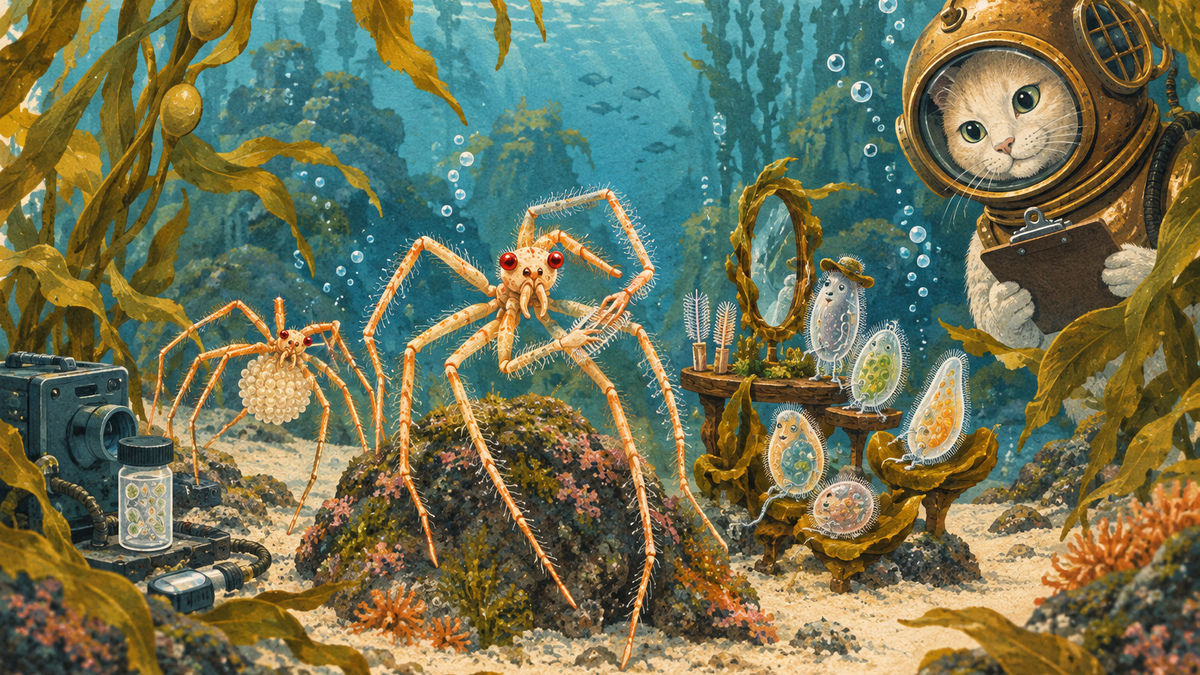
The proprietor, Callipallene pilosuspedes, declined to answer questions directly, partly because its triangular mouth has three lips and partly because it was busy combing its own legs with a pair of specialised appendages.
“That is either impeccable self-care or a serious conflict of interest,” said Miso, the bureau’s cream-coloured cat inspector, speaking through a brass diving helmet. “I booked the 3:15.”
The salon, provisionally named The Hairy Foot, occupies a tasteful patch of kelp between a rock and another rock. Services include spine polishing, proboscis detailing and a twelve-leg package whose price is listed simply as “ask your plankton adviser.” No actual hair is involved. The establishment’s signature look comes from long, curved spines on the lower legs, proving once again that marine fashion has little respect for ordinary vocabulary.
Business intensified when a second newly described species, Tanystylum kiixin, arrived carrying eggs and several extremely small passengers. Its egg-carrying limbs are less suited to grooming, making it the natural target market for a salon staffed by a compulsive self-brusher.
“An ecosystem within an ecosystem within an ecosystem,” whispered Miso, counting the spider, debris and tiny parasites on a waterproof clipboard. “In cat terms, this is a blanket on a lap on a heated chair. Structurally excellent.”
The parasites immediately requested loyalty cards. Management refused, explaining that nobody could determine whether they were customers, accessories or an unauthorised pop-up business.
A public hearing followed. Local jellyfish complained that the salon’s slogan—“We take a little off the top”—was distressingly ambiguous for animals living near predators with sucking mouthparts. The kelp association demanded quieter combs. A delegation of crabs objected that four pairs of legs should not qualify anyone as an influencer.
Miso dismissed every complaint after learning that researchers had found only one specimen of C. pilosuspedes. “This is not an invasion,” the inspector ruled. “It is a very exclusive appointment book.”
The salon was approved on three conditions: no frightening swimmers, no unlicensed use of the phrase “deep cleanse,” and all egg-carrying fathers receive one complimentary treatment. The last clause passed unanimously after the council realised male sea spiders carry developing eggs.
At sunset, the new proprietor polished one final leg while bubbles drifted through the kelp. Miso closed the report with an official recommendation: science should keep looking, the sea should keep its mysteries, and every creature—no matter how many lips it has—deserves a decent comb.
The real news behind the joke
University of British Columbia researchers have described two new sea-spider species from the Salish Sea: Callipallene pilosuspedes and Tanystylum kiixin. They are the first new sea-spider species described from the region in almost a century. The peer-reviewed work combined detailed imaging with DNA analysis and was published in Organisms Diversity & Evolution.
Researchers collected specimens between September 2023 and August 2024 during dives as deep as 18 metres around Quadra Island, Vancouver, Bamfield and Victoria. C. pilosuspedes has long curved spines that inspired its “hairy feet” name, red eyes, a three-lipped mouth and dexterous ovigers observed grooming its legs. The team reported finding only one specimen. T. kiixin was named for an ancient Indigenous village site near where specimens were first collected; the name is pronounced “kee-hin” and refers to the sound of waves at the site. Researchers often found its specimens carrying debris and tiny parasites.
Sea spiders are marine arthropods related to spiders, scorpions and horseshoe crabs, but they are not true spiders. In these animals, males carry developing eggs. The study also generated genetic data for species not previously sequenced and produced a regional identification guide—useful groundwork for understanding how coastal biodiversity responds to climate change and human disturbance.
Sources
- University of British Columbia: Hairy-legged red-eyed sea spiders discovered in the Salish Sea (23 September 2026)
- Organisms Diversity & Evolution: peer-reviewed study, DOI 10.1007/s13127-026-00707-3
- USA Today: New sea spider species has hairy legs, red eyes and 3 lips (25 September 2026)
Illustration disclosure: The feature image was generated with AI as an editorial cartoon. It does not depict an actual specimen or research scene.