Cats Approve Orbital Cloud, Demand Sunbeam-Level Service
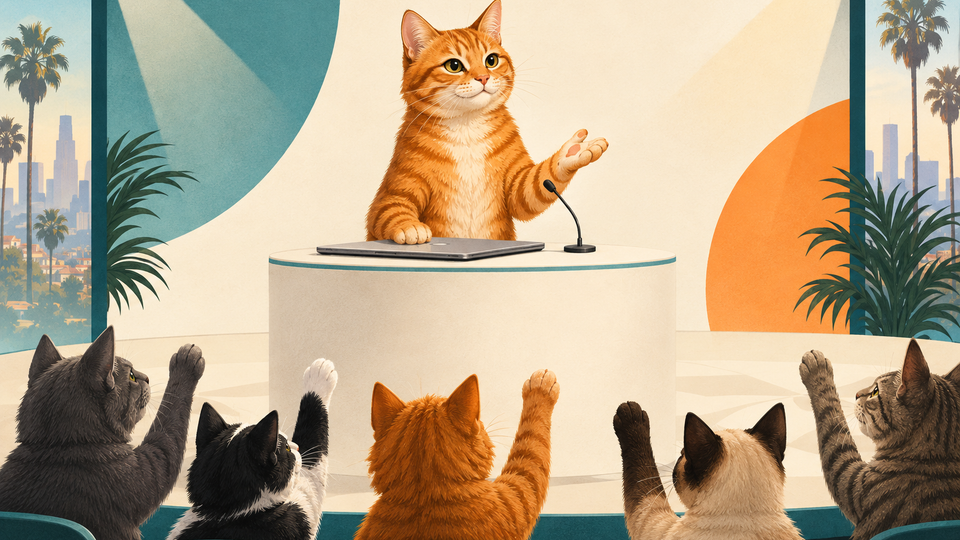
Google is testing AI chips in orbit, so the feline cloud council has issued one condition: every server rack must come with a sunbeam.
Cat parody / satire. The feline characters, quotations and events below are fictional. The factual background appears separately at the end.
Cats Approve Orbital Cloud, Demand Sunbeam-Level Service
The International Feline Cloud Council has granted conditional approval for humanity’s latest attempt to put artificial intelligence in space, provided the equipment passes a rigorous three-part inspection: Is it warm? Does it blink? Can a cat sit on it while an engineer is trying to work?
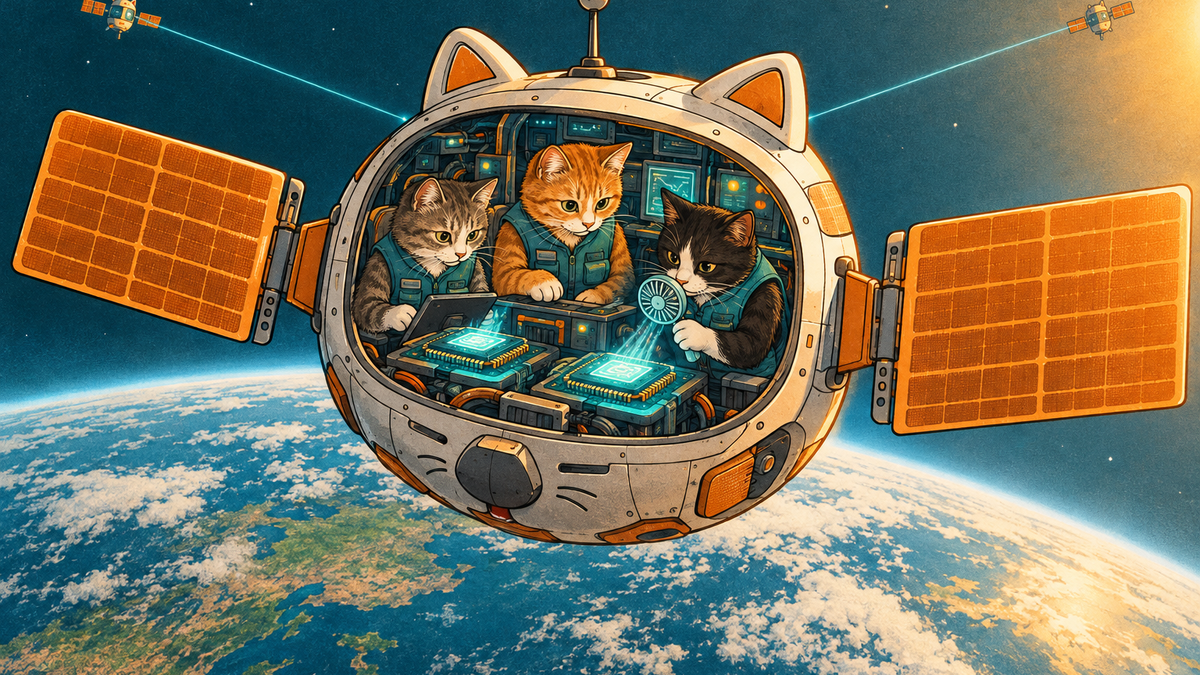
The emergency session began after reports reached the council that Google plans to test its Tensor Processing Units aboard a prototype satellite. Delegates immediately recognized the strategic implications. For decades, cats have tolerated Earth-based data centers—vast rooms of humming cabinets that produce premium-grade heat yet remain scandalously difficult to nap upon. Moving the machinery closer to the Sun, several members argued, could finally correct this design failure.
“The cloud has spent years pretending to be in the sky,” said Chaircat Miso von Whisker, pointing at a laser pointer she had personally knocked off the lectern. “At last, somebody is taking the diagram literally.”
The proposed orbital facility would not, officials stressed, be a complete data center. It is an early hardware test. This clarification disappointed a queue of cats who had arrived carrying résumés for the positions of Chief Warmth Officer, Senior Cable Inspector and Unscheduled Keyboard Input Specialist.
Still, preparations continued. Engineers presented a list of hazards: rocket vibration, radiation, wild temperature swings and the difficulty of cooling powerful chips in a vacuum. The council added several overlooked risks, including drifting toy mice, unauthorized antenna chewing and the possibility that a processor might become occupied precisely when its owner needs it.
A prototype cooling plan involving heat pipes and radiators received cautious support. A competing feline proposal—“push the hot thing three centimeters away and lie where it used to be”—was praised for elegance but returned for additional modeling.
Solar power proved less controversial. Project Suncatcher’s larger concept imagines satellites using near-continuous sunlight and eventually communicating through high-bandwidth optical links. To cats, this sounded like an infinite sunbeam connected by interplanetary laser pointers, a combination so persuasive that the vote briefly dissolved into sprinting.
Not everyone was convinced. Opposition leader Professor Socks warned that orbital computing could create a serious accountability gap. “When an AI answers incorrectly on Earth, we can sit on the router,” she said. “At several hundred kilometers up, our traditional regulatory tools become ineffective.”
The council therefore issued a provisional framework. Every future satellite cluster must include redundant cardboard boxes, a transparent policy on tuna-related workloads and one Earth-facing camera reserved for judging humanity. Laser links may be activated only after all nearby cats have been informed that the red dot is not, in fact, catchable.
As the meeting adjourned, Chaircat Miso summarized the mood: “We support scientific exploration. We support abundant clean energy. We especially support any machine that crosses a rocket launch, cosmic radiation and the vacuum of space merely to become a warmer place for us to sleep.”
The prototype’s real task is more modest: find out what survives, what fails and what engineers need to redesign. That is sensible moonshot procedure. It is also, coincidentally, how cats test every object delivered in a cardboard box.
The real news behind the joke
Google announced on September 24, 2026 that Project Suncatcher is preparing its first in-orbit test. A prototype satellite developed with Planet is due to ride on SpaceX’s upcoming Transporter-18 mission and collect data on how Google TPUs handle launch forces, radiation and thermal extremes. This is an experimental hardware mission—not the launch of a full orbital data center.
The longer-term research idea is to place solar-powered AI hardware in low Earth orbit and eventually connect satellite clusters with high-bandwidth optical links. Google says panels in the right orbit could generate up to eight times more power than on Earth, while acknowledging major unresolved engineering challenges. Reuters independently reported the planned test on September 24.
Sources
- Google: Behind Project Suncatcher, our moonshot to put AI in space (September 24, 2026)
- Google Research: Exploring a space-based, scalable AI infrastructure system design (November 4, 2025)
- Reuters via WTAQ: Google plans first test of AI chips in space (September 24, 2026)
The feature illustration was generated with AI for this fictional feline news satire.