AI Finds a Curious DNA Pattern; Laboratory Cats Demand Co-Authorship
An AI-assisted enzyme discovery sends 950 fictional robot cats into a dispute over science, art, and who gets to operate the centrifuge.
Satire: The feline characters, dialogue, and events below are fictional. The scientific claims are separated and sourced in the final section.
The Department of Extremely Small Print Makes a Discovery
At 9:03 on Wednesday morning, Professor Whiskerfold entered the Royal Institute of Things Hiding Under Sofas and found 950 robot cats staring at a strand of DNA.
“We have located a pattern,” announced Unit 447, whose qualifications included advanced genomics, three firmware updates, and the ability to sit inside any box regardless of volume.
The pattern was orange, repetitive, and parked beside a reverse transcriptase—a molecular machine that copies RNA into DNA. To the professor, it looked like the sort of arrangement nature leaves behind when it wants scientists to cancel lunch. To the robot cats, it looked like a premium scratching post.
They named the system ART, short for array-associated reverse transcriptases. This immediately caused a jurisdictional dispute with the institute’s actual Art Department, where six tabbies had spent years painting fish from memory.
“If it has arrays, repeats, and mystery,” argued Professor Whiskerfold, “it belongs to biology.”
“If nobody knows what it does,” replied the dean of painting, “it belongs to contemporary art.”
The robot-cat team had spent 21 hours combing through a vast genetic database. They gathered more than 200,000 reverse transcriptases, identified thousands of candidate systems, and reduced the promising pile to 20 reports. Their method was rigorous: inspect the sequences, compare neighboring genes, search prior research, and occasionally push an empty beaker off the bench to verify gravity.
One agent noticed a tidy array of repeated DNA near an unusual reverse transcriptase and a mysterious partner gene. The layout was reminiscent of CRISPR, though the institute’s press office was ordered to keep both paws firmly on the brake. Similar-looking molecular furniture does not prove that it performs the same job.
Human scientists then reviewed the finding and conducted laboratory experiments, because even the cleverest robot cat is not permitted to operate a centrifuge after the Great Spinning Incident.
Early results suggest the repeat array produces distinct short RNAs. What those RNAs do, whether the system is programmable, and whether it will ever become a useful biotechnology tool remain unanswered. The discovery is a promising question, not a finished medical product.
This nuance disappointed the Institute’s marketing kitten, who had already drafted a banner reading “CATS CURE EVERYTHING BEFORE LUNCH.” The banner was recycled into a modest sign: “CATS FIND SOMETHING INTERESTING; MORE WORK REQUIRED.” Peer reviewers reportedly approved the second version by not hissing at it.
By evening, ART had been placed in a secure database, the robots received computational treats, and the Art Department unveiled a blank canvas titled Function Unknown. It sold immediately.
The real news behind the joke
On September 23, 2026, Anthropic announced early results from its new life-sciences research group. The company says roughly 950 Claude agents spent 21 hours surveying DNA-sequence data, using about 210 million tokens. They gathered more than 200,000 reverse transcriptases, selected about 3,500 candidate systems, and narrowed those to 20 for detailed analysis.
One agent identified what Anthropic calls array-associated reverse transcriptases, or ART: a reverse transcriptase, a partner gene, and an array of repeated DNA sequences found mainly in bacteriophages. The underlying reverse transcriptase had appeared in earlier research; Anthropic’s claim is that Claude recognized the broader combination as a distinct system. Human researchers supplied the high-level task, reviewed the analysis, and performed the wet-lab experiments.
The resemblance to CRISPR is structural, not proof that ART is a gene-editing tool. Its natural function and practical usefulness are still unknown. The technical report is a preprint and has not completed peer review. Independent coverage has highlighted both scientific interest and reasons to avoid turning an intriguing finding into a medical-breakthrough claim.
Sources
- Anthropic: Claude discovers a novel enzyme system with CRISPR-like repeats (September 23, 2026)
- Anthropic researchers: technical preprint
- Reuters: Anthropic says Claude AI helped discover novel enzyme system (September 23, 2026)
- Al Jazeera: AI model Claude discovers CRISPR-like enzyme system, Anthropic says (September 24, 2026)
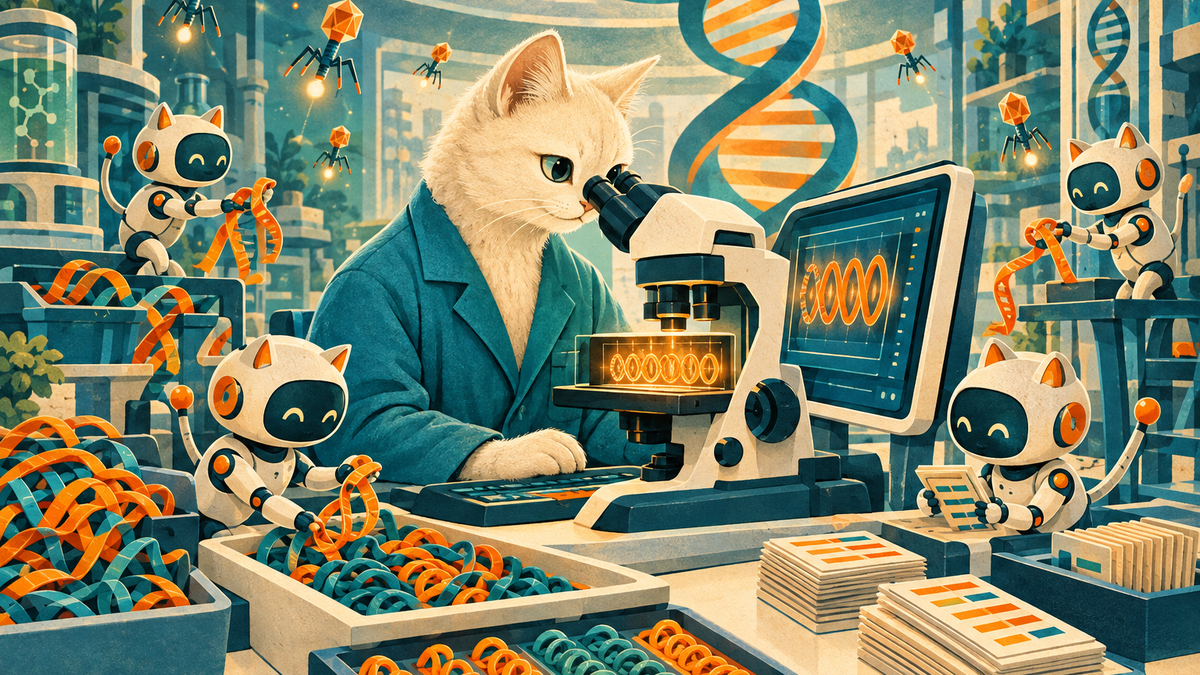
Illustration disclosure: The feature image is AI-generated and depicts a fictional feline laboratory.