Moon Cats Discover Someone Filed a Crater Without a Permit
A once-in-a-century lunar crater triggers a very serious feline paperwork emergency.
Cat parody / satire: The feline officials, quotations and lunar bureaucracy below are fictional. The factual report follows under “The real news behind the joke.”
Moon Cats Discover Someone Filed a Crater Without a Permit
The Lunar Department of Unexpected Holes confirmed Tuesday that a vast new crater has appeared near the Moon’s eastern edge, despite no record of a planning application, environmental review or properly stamped Form 9-LIVES.
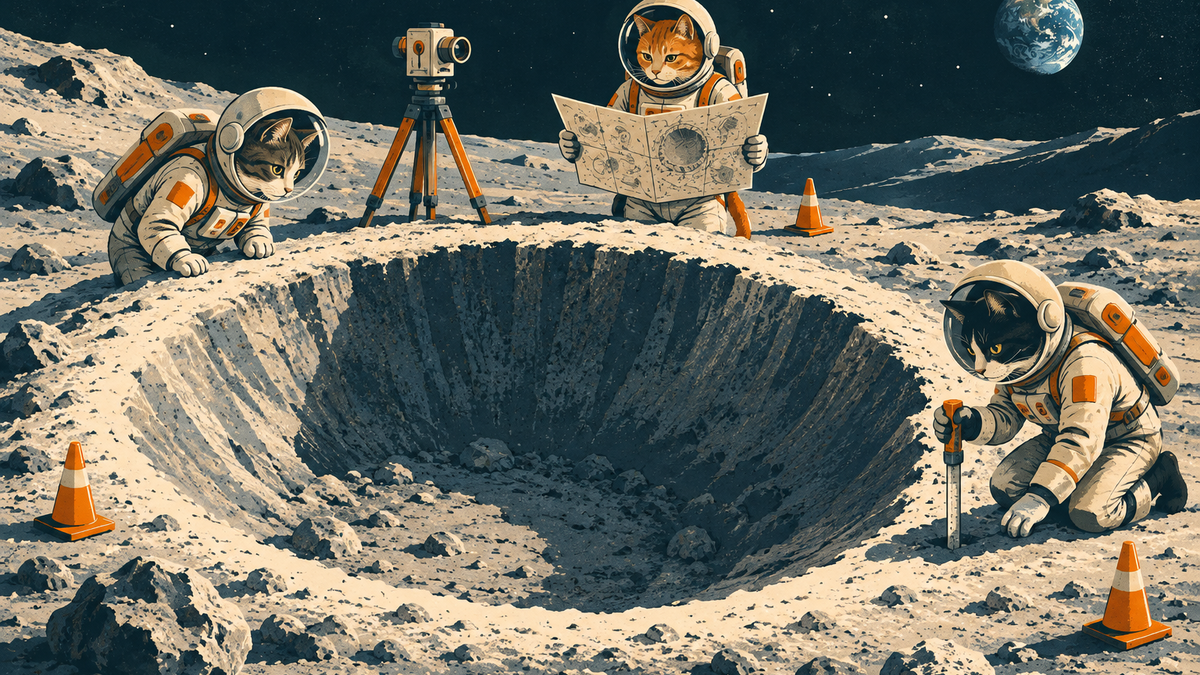
Chief Inspector Miso, a silver tabby wearing a helmet several sizes too large, arrived at the site with two assistants, a measuring tape and the serene confidence of a cat who had never read the instructions. After walking around the rim once, Miso declared the hole “substantially larger than the box it came in.”
The department immediately erected three orange safety cones. One fell over. A second drifted slowly downhill. The third was sat upon by Deputy Surveyor Marmalade, who explained that lunar furniture remains critically underfunded.
Officials believe the unlicensed renovation was carried out by an asteroid or comet fragment employing what investigators called the “extremely rapid delivery method.” The contractor did not leave a forwarding address, warranty card or apology.
“We have strict rules about digging,” Miso told an emergency press conference attended by one rover and a rock that looked interested. “A hole of this size requires twelve signatures, a dust-management plan and proof that all displaced regolith has been offered a suitable litter tray.”
The crater’s surrounding ground was also found to be unusually chilly at night. This prompted the Department of Lunar Comfort to issue tiny knitted booties, which the survey team rejected on professional grounds before quietly putting them on.
Meanwhile, engineers are studying how debris from major impacts travels across the lunar surface. The Cat Council has responded with a three-part infrastructure strategy: reinforce future habitats, keep delicate equipment away from incoming space rocks, and stare very hard at the sky as though this might help.
The crater has been named McGetchin. Feline administrators briefly proposed “The Great Bowl,” “Mare Meow-joris” and “That Wasn’t There Yesterday,” but withdrew all three after learning that scientists had already completed the paperwork.
At sunset, Inspector Miso closed the investigation. The impactor remains at large, the crater remains extremely present, and Form 9-LIVES has been returned because somebody checked both “asteroid” and “comet.”
The real news behind the joke
NASA reported on September 16, 2026, that scientists using the Lunar Reconnaissance Orbiter had identified McGetchin, the largest newly formed crater yet found in the solar system. It formed near the Moon’s eastern edge between April 11 and May 22, 2024, when an asteroid or comet fragment roughly the size of a three- to six-story building struck the surface.
The crater measures about 222 metres (728 feet) across and 43 metres (141 feet) deep. The LROC team says models put an impact of this scale at roughly once every 132 years on the Moon. Follow-up observations found surface disturbances more than 100 kilometres away. NASA’s Diviner instrument also detected a roughly four-mile-wide area that is colder at night because the impact loosened the regolith, making it less able to retain heat.
Robert Wagner, an image-processing specialist working with LROC data, noticed the telltale bright area and dark halo while conducting a routine data-quality check. Before-and-after imagery and sharper follow-up observations established the crater’s size and scientific importance. Researchers say the fresh site can improve impact models and help engineers assess risks to long-lived lunar infrastructure.
Sources
- NASA Science — “NASA’s Moon Orbiter Spots New, ‘Once-in-Century’ Moon Crater” (September 16, 2026)
- Lunar Reconnaissance Orbiter Camera — “Spectacular McGetchin Crater” (September 16, 2026)
- USRA/Lunar and Planetary Institute — discovery release (September 16, 2026)
- Associated Press via NBC News — independent report (September 16, 2026)
Illustration disclosure: The feature image is an AI-generated editorial illustration. It does not depict an actual lunar scene or NASA imagery.