Cat Space Agency Tests Asteroid Probe, Finds Chief Engineer Inside
A fictional feline space agency discovers that qualifying a probe for deep space is easier than persuading its engineer to leave the box.
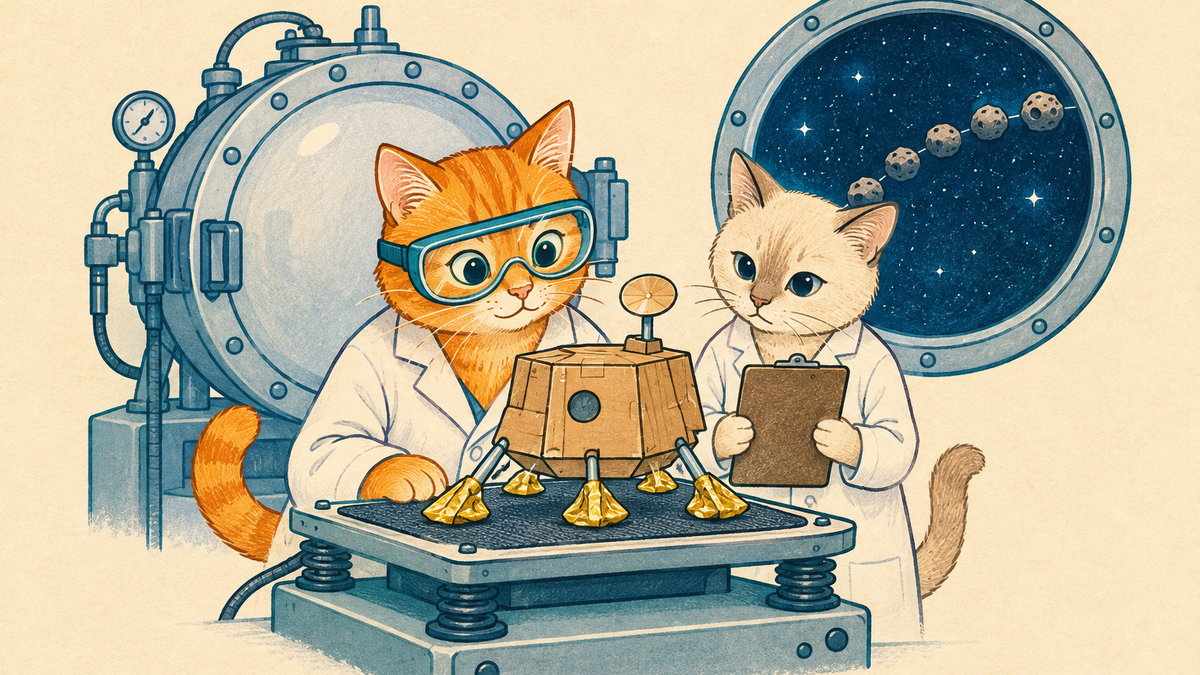
Cat-world satire: The following newsroom dispatch is fiction. Its cats, dialogue, institutions and cardboard engineering are invented; the real science news that inspired it appears separately below.
The Feline Space Agency unveiled its newest asteroid probe this morning, then immediately postponed the unveiling because its chief engineer was inside it.
Dr Marmalade emerged from the cardboard chassis after fourteen minutes, declared the internal volume “scientifically excellent,” and refused to explain why the thermal blanket now contained a small, perfectly circular sleeping depression.
The agency’s ambition is straightforward: visit a succession of distant space rocks, learn something useful about the solar system, and establish whether a box remains a box when nobody is available to sit in it. The third objective has consumed most of the committee’s attention.
“Human engineers build instruments that can survive extraordinary conditions,” said mission director Professor Crumb. “We have built an instrument that can survive our procurement department. Naturally, further testing is required.”
The probe’s first qualification trial involved a shaker platform. Engineers wanted to check that its components stayed attached during launch-like vibration. Marmalade wanted to check whether the platform could dislodge a treat wedged under the left landing foot.
Both investigations were successful. The treat emerged, the landing foot remained attached, and the quality-assurance officer recorded a minor anomaly involving the disappearance of the treat before its serial number could be photographed.
Next came thermal-vacuum testing, which the agency initially misunderstood as leaving the spacecraft beside a warm radiator while the cleaner worked nearby. This interpretation was withdrawn after the cleaner switched on her machine and the entire engineering division evacuated behind a filing cabinet.
A proper chamber was subsequently installed. It was inspected by three cats, each of whom approved its rounded interior before objecting to the absence of a sunbeam. The chamber’s operating manual now begins with a warning that “cozy” and “space-qualified” are not interchangeable specifications.
The mission’s navigation team has also rejected proposals to visit only asteroids that resemble kibble. According to chief navigator Lentil, the scientific value of a destination cannot be determined by whether somebody wants to lick it.
“We are examining ancient material, not compiling a tasting menu,” she told reporters, while removing a paw-drawn fish from the trajectory display.
The final destination has caused a separate administrative dispute. The agency’s property committee insists that any rock reached by a cat automatically becomes that cat’s rock. Legal counsel disagrees, arguing that the universal feline principle of “I was here first” becomes difficult to apply after a journey lasting years.
A compromise permits the spacecraft to observe the asteroid without claiming ownership, provided the observations are conducted with the unmistakable expression of someone who might claim ownership later.
Meanwhile, the onboard computer is being trained to select useful pictures rather than transmit every image indiscriminately. Early tests produced two photographs of the target, forty-seven photographs of a dangling cable, and one dramatic close-up of Marmalade’s nose.
The nose image has been retained as a calibration reference. Nobody knows what it calibrates, but deleting it would require another meeting.
At the closing briefing, Crumb reminded the team that real exploration demands patient testing, careful planning and respect for uncertainty. The room nodded solemnly. Then a junior technician asked whether the empty shipping carton could be made available immediately.
For the first time all day, the agency reached a unanimous decision.
The real news behind the joke
Two reports dated 4 October 2026 describe progress on the UAE-developed deployable probe for the Emirates Mission to the Asteroid Belt. The official announcement says it will ride aboard MBR Explorer on a planned journey of approximately five billion kilometres exploring seven asteroids, ending at 269 Justitia, with launch planned from Japan in the first quarter of 2028.
The National reports completed vibration testing and ongoing thermal-vacuum testing, with additional checks remaining. It gives a planned March 2028 launch and 2036 arrival at Justitia, after flybys of six other asteroids. These are future plans, not completed milestones. Studying Justitia could help researchers understand the distribution of water and organic materials during planetary formation; these reports do not announce a discovery of life.
Sources
- Official announcement: Hamdan bin Mohammed witnesses unveiling of UAE-developed probe — 4 October 2026.
- The National: UAE’s MBR Explorer probe enters final tests for 2028 mission — Shireena Al Nowais, 4 October 2026.
Illustration disclosure: AI-generated editorial cartoon; fictional cats and spacecraft, not a technical depiction of the real mission.