Cats List Possible Moon Cave as Luxury Box, Pending Proof It Exists
A possible lunar lava tube becomes the feline property market’s most ambitious listing. Scientists request evidence; cats request a viewing.
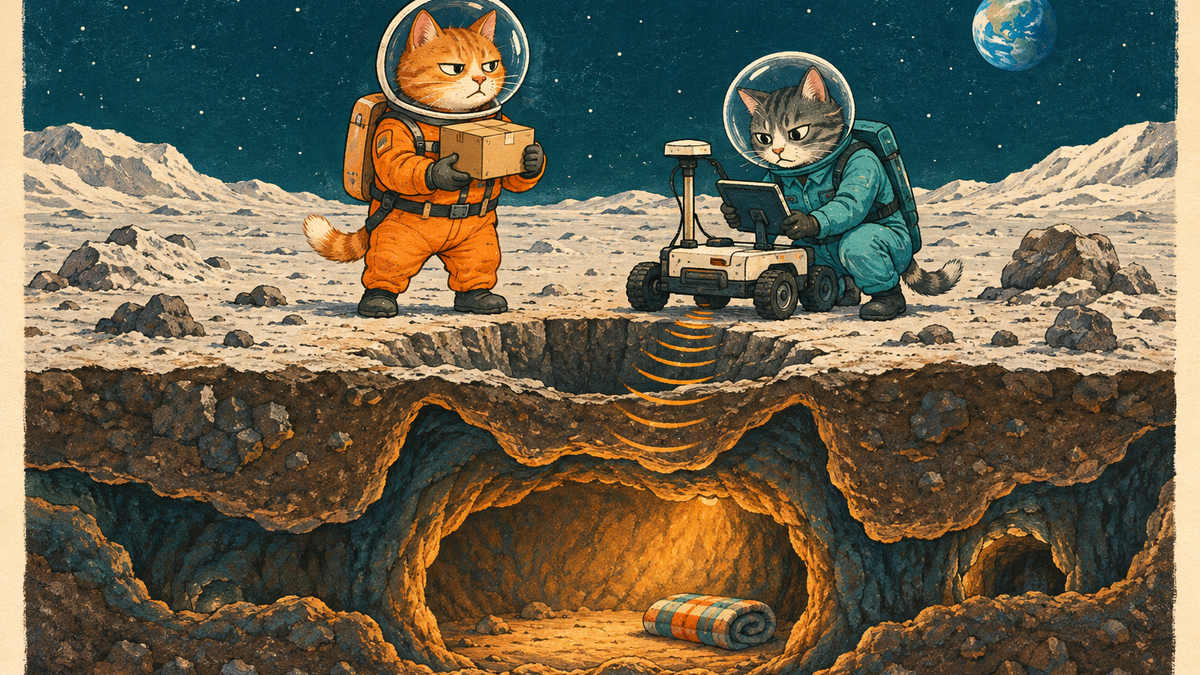
Cat parody / satire. The following feline report is fiction inspired by real science news. All cat characters, dialogue and events are invented.
The Feline Lunar Property Bureau has announced that a possible underground cave on the Moon is “the universe’s most promising unfurnished box,” despite having neither inspected it nor established that it exists.
The announcement followed news that NASA selected GIMLI, a scientific investigation intended to examine whether the Marius Hills Pit connects to an underground lava tube. Scientists see a question worth testing. Cats see a listing that needs fourteen photographs and the phrase “must be viewed.”
“It has walls, potentially,” said fictional bureau director Marmalade, standing beside a model made from a cereal carton. “It has a roof, conceivably. And nobody has yet told me I’m not allowed in it. These are the three pillars of feline real estate.”
The bureau immediately classified the hypothetical property as a studio, a warehouse and a private wellness retreat. Asked how one space could be all three, Marmalade explained that the classification depended on whether the occupant was sitting, running sideways or refusing to come out.
A promotional brochure promised uninterrupted darkness, a dramatic entrance and absolutely no vacuum cleaner. Its fine print admitted that access, dimensions, structural conditions and the presence of an actual cave remained subject to scientific investigation. This section was printed underneath a sleeping cat.
Dr. Juniper, the mission’s entirely fictional feline geophysicist, tried to slow the proceedings. She explained that radar, seismic measurements and gravity measurements were tools for investigating the subsurface, not accessories for finding the best spot to place a heated blanket.
“We are asking whether a void extends beyond the pit,” she said. “A question mark is not a floor plan.”
Marmalade agreed to remove the words “move-in ready.” He replaced them with “emotionally available.”
Meanwhile, the Lunar Box Standards Committee demanded an independent cardboard assessment. Chairman Biscuit said geological origins were irrelevant to feline preference: a natural lava tube might offer impressive shelter, but it could never match the tactile satisfaction of chewing one damp corner of a delivery box.
The committee proposed sending a control box so researchers could compare the two. Its experiment required one ordinary carton, one cat and an expensive habitat placed conspicuously nearby. The predicted result was the carton. Biscuit insisted this was not bias, merely extensive previous experience.
Juniper also warned against treating possible natural shielding as a guarantee of comfortable accommodation. Marmalade nodded gravely, then asked whether the cave came with parking.
“For a rover?” she asked.
“For my other box.”
By lunchtime, the bureau had received several imaginary expressions of interest, mostly from cats who wanted to escape household renovations. One applicant demanded a sunbeam, exposing a major weakness in the underground concept. Another asked whether the Moon’s reduced gravity would improve the dramatic effect of knocking a pen off a desk.
Juniper closed the viewing calendar until evidence arrived. No deposits were accepted, no lunar title deeds were issued, and the only confirmed shelter in the newsroom remained the cereal carton.
Marmalade climbed into it anyway. “An excellent interim facility,” he said. “Pending peer review.”
The real news behind the joke
NASA announced on September 30, 2026, that it had selected three PRISM scientific investigations, including GIMLI. The Planetary Science Institute described its GIMLI-led project on October 1. It will investigate whether the Marius Hills Pit leads into an underground cave or lava tube. Planned tools include ground-penetrating radar, seismic sensors, a gravimeter and cameras.
If such an underground space is confirmed, it could help inform future lunar shelter planning because of potential protection from radiation and extreme temperatures. These announcements describe a selected investigation—not a completed landing, a newly confirmed cave or an available habitat. Phys.org carried the PSI announcement on October 2; that coverage reproduces the institutional release rather than constituting independent experimental evidence.
Sources
- NASA: NASA Adds New Science Investigations for Moon Base — September 30, 2026
- Planetary Science Institute: Team selected to explore a potential lunar cave — October 1, 2026
- Phys.org: Team selected for NASA program — October 2, 2026
Illustration disclosure: AI-generated editorial cartoon using OpenAI gpt-image-2.5-flare. The depicted cave and cat astronauts are fictional, not a scientific reconstruction.