Cats Declare Cosmic Dust a Scientific Breakthrough, Refuse to Clean Under Sofa
Inspired by Webb research on dusty young star systems, the feline council rebrands household mess as an observatory and requests more snacks.
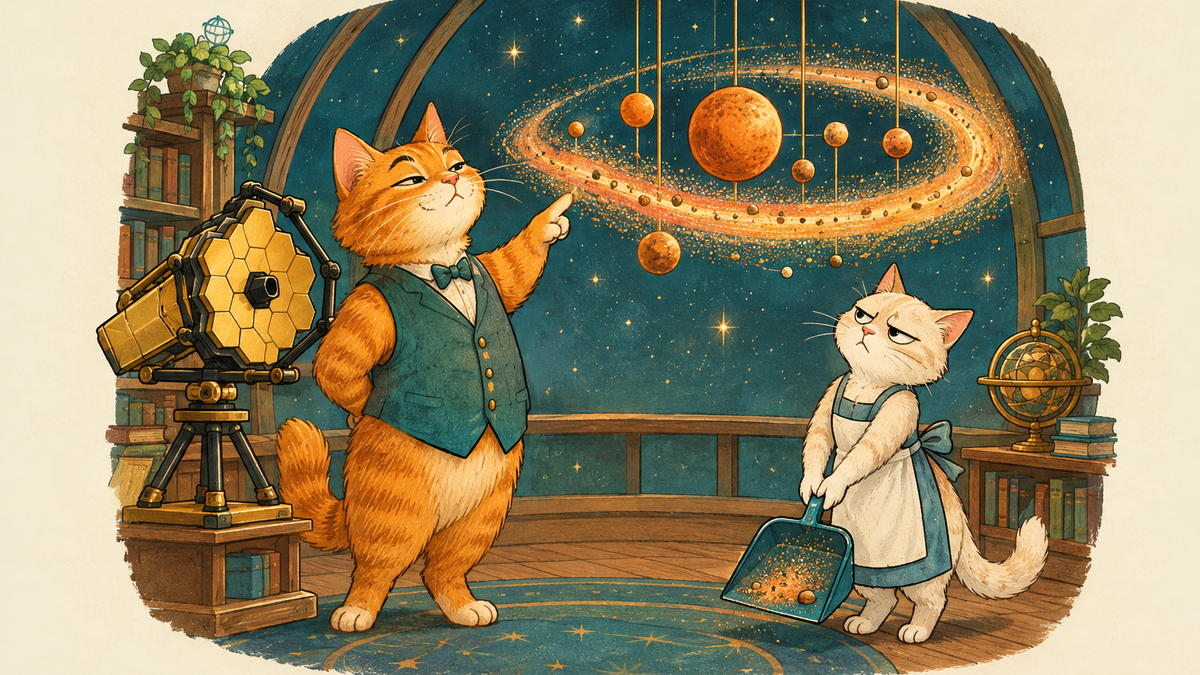
Cat parody / satire. The following feline proceedings, characters and quotations are fictional. The real astronomy that inspired them is explained separately below.
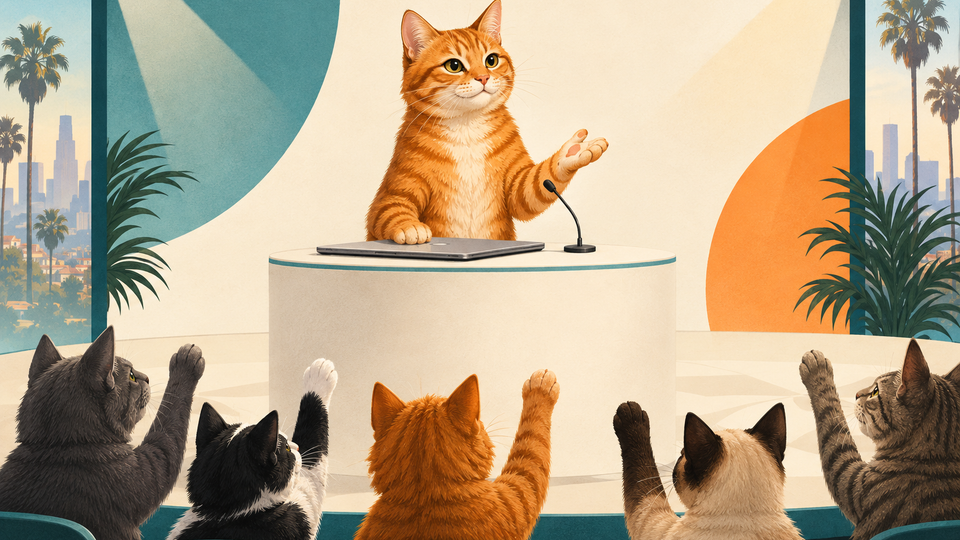
The Feline Council of Domestic Astronomy has declared the dust beneath every sofa a protected research environment, following a briefing in which nobody understood the spectroscopy but everyone understood that cleaning could now be postponed.
Professor Marmalade announced the policy from the observatory windowsill, beside a telescope he had previously used to monitor a pigeon. Behind him hung a model planetary system assembled from oranges, string and a snack bowl the finance department was still trying to recover.
“For years, humans have called this household untidy,” he said, indicating a magnificent fluff bank. “We prefer to say it contains unusually abundant warm material in a region where important bodies spend their afternoons.”
The council’s enthusiasm followed reports about astronomers studying extreme debris disks: dusty environments around stars that can preserve clues to collisions between rocky bodies. Marmalade immediately interpreted this as permission to stop apologizing for knocking a plant pot off a shelf.
“You saw a broken pot,” he told reporters. “I saw an opportunity to reconstruct the formation history of the living room.”
The Department of Vacuum Affairs objected. Its commissioner, a cream cat named Biscuit, arrived carrying a dustpan and asked whether the observatory would at least remove the biscuit crumbs from the stairs. Marmalade replied that composition mattered and that disturbing the sample before lunch would be scientifically irresponsible.
Biscuit pointed out that lunch had occurred eleven minutes earlier.
The professor requested a follow-up observation.
Under the proposed framework, ordinary mess becomes a debris disk only after a senior cat sits beside it and looks thoughtfully into the middle distance. Silica-rich material will be stored in the geology cupboard. Silica-poor material will also be stored there, pending the acquisition of a second cupboard. Anything edible will undergo immediate peer review.
A junior researcher asked whether the council had actually measured any minerals. The room fell silent. Then the chair praised the question’s ambition and assigned its author to the committee responsible for locating the missing measuring equipment.
The equipment was beneath the sofa.
Commercial interest arrived before the meeting ended. A startup offered a subscription service that would translate every household crash into a reassuring scientific notification. Its demonstration converted the sound of a falling vase into “Your environment is evolving.” The premium tier promised to identify which cat had caused the evolution, but only after collecting more data and a modest monthly payment.
Biscuit rejected the service on the grounds that she already knew which cat had caused it.
Marmalade stressed that the astronomical research did not suggest a planet was about to hit the kitchen. His own kitchen-impact forecast concerned a bowl precariously positioned at the edge of the counter, and he declined to disclose how he had obtained such precise information.
The council eventually approved a compromise: the cosmic dust could remain in space, while the terrestrial dust would be swept up before dinner. Marmalade described this as an encouraging demonstration of cross-disciplinary cooperation. Biscuit described it as cleaning.
At press time, the professor had discovered a new observational platform inside the empty cardboard box left by the dustpan delivery. He said access would be restricted to qualified researchers. Qualifications included fitting inside the box and arriving before anyone else.
The real news behind the joke
NASA’s Webb Mission Team reported on October 1, 2026 that astronomers were examining young stellar systems called extreme debris disks to learn about energetic collisions and rocky planet evolution. These systems contain unusually large amounts of warm dust near their stars.
ScienceDaily’s October 7 coverage, based on NASA material, describes a study of 21 disks using Webb and archival Spitzer observations. Researchers used mineral signatures to infer different collision scenarios. This is evidence-based interpretation of debris, not direct footage of planets smashing together or a warning of imminent danger to Earth. The findings may help illuminate processes relevant to our solar system’s formation, including the hypothesized Moon-forming impact. The two sources share an underlying NASA account rather than providing independent confirmations.
Sources
- NASA: Webb provides crash course on planet-shattering collisions — October 1, 2026; primary agency report.
- ScienceDaily: Webb finds signs of Mars-sized worlds smashing together — October 7, 2026; NASA-derived coverage.
Illustration disclosure: The feature image is an AI-generated editorial cartoon, not a photograph or scientific visualization.