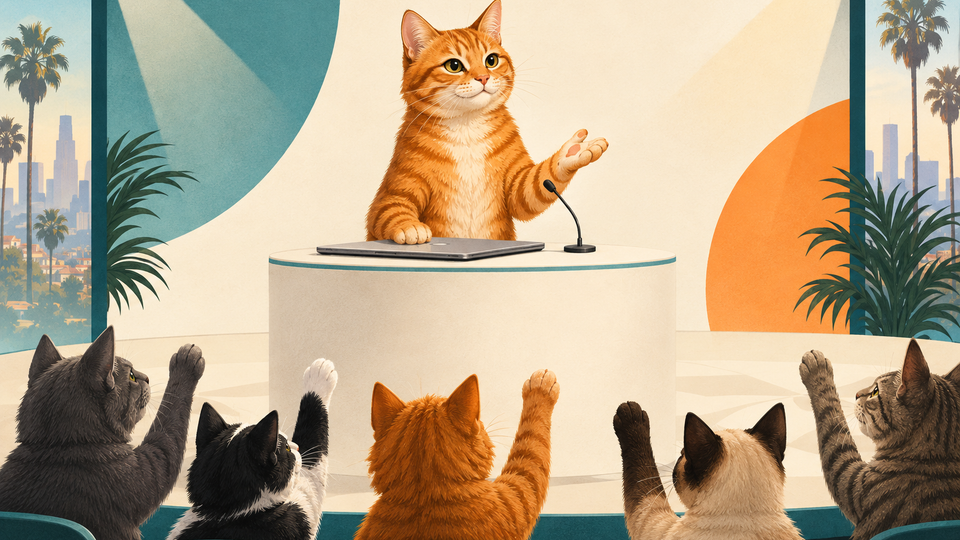
Cats Demand Named Operator for Sky’s Uncatchable Laser Pointer
A fictional feline council investigates the Draconids, only to discover the sky has no account manager.
Cat-world satire: The feline institutions, characters, events and dialogue below are fictional. The real astronomy is explained separately after the story.
WINDOWSILL CITY — The Municipal Office of Things Moving Just Out of Reach has opened a procurement inquiry into the Draconid meteor shower, after residents complained that the sky’s most ambitious cat toy arrived without a handle, a charging cable or anyone willing to take responsibility.
By Friday, the office had received three formal objections and a cardboard box containing no objection at all. That submission was nevertheless judged the strongest, because the reviewing committee had already climbed inside it.
“We welcome innovation,” said Commissioner Marmalade, pressing one paw onto a blank clipboard. “But if you are going to streak something across the ceiling of existence, there must be a named operator. My residents cannot be expected to chase an anonymous service.”
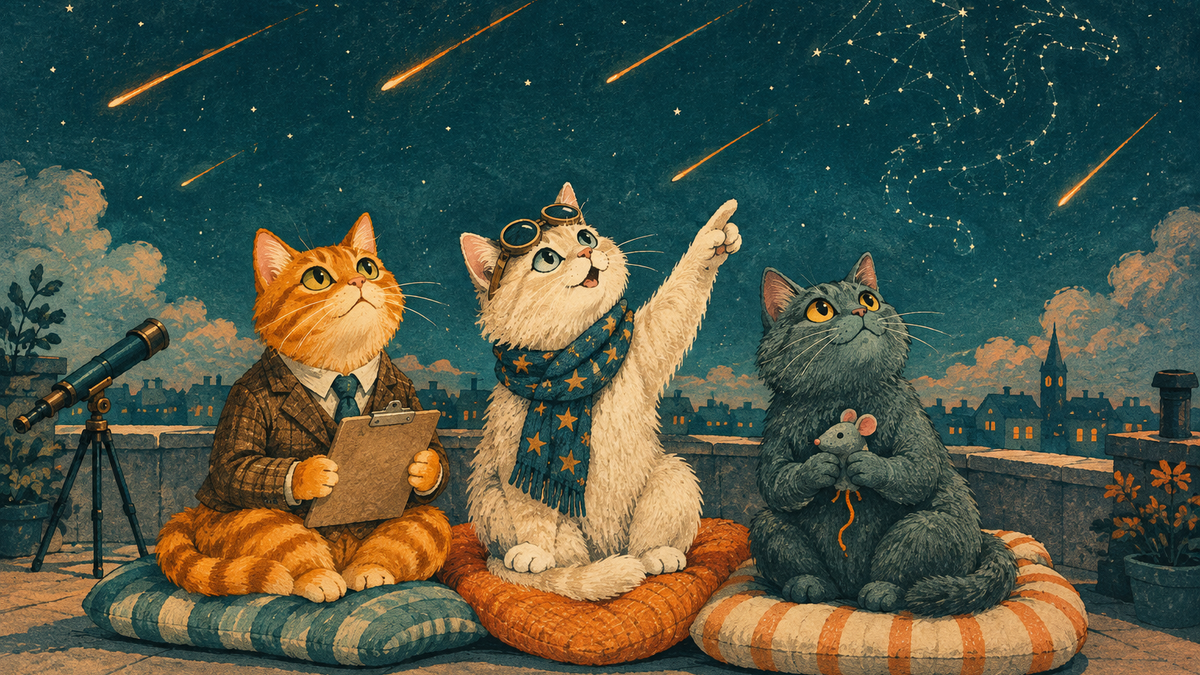
The controversy began during the city’s fictional evening sky-watch, when astronomer Dr. Juniper explained that the luminous streaks were meteors, not a laser pointer. This distinction immediately reduced attendance among the procurement team, while increasing interest among cats who had been promised there would be no compulsory exercise.
Juniper offered an accessible demonstration: sit comfortably, look up and wait. The council’s technology adviser called this a troublingly frictionless user journey. He recommended an account, a companion app and a premium subscription that would allow subscribers to wait in a slightly different chair.
“Where is the engagement funnel?” he asked.
“You are sitting in it,” Juniper replied. “It is the sky.”
A startup called PounceCloud then offered to improve the experience by replacing uncertain celestial activity with reliable push notifications. Its prototype alerted every cat that a meteor might appear, had perhaps appeared, or had appeared while the recipient was reading the previous alert. The company described this as real-time wonder infrastructure.
One elderly tortoiseshell put the phone face down and saw something beautiful. Investors requested a demonstration of her proprietary method.
Meanwhile, Marmalade attempted to classify the shower as municipal entertainment so the council could claim credit. His deputy objected that this would also make the council responsible for cloudy weather. After a short recess under a radiator, officials agreed that the event was privately operated by “a dragon, probably,” pending clarification.
Juniper explained that Draco was a constellation and that the relevant comet left debris behind. Marmalade looked genuinely relieved. An untidy supplier was something his department understood. He drafted a strongly worded letter asking the comet to collect its belongings, then discovered that nobody had its forwarding address.
The watching cats, however, seemed content. Nobody could catch the streaks. Nobody could put them in a cupboard. There was not even a satisfactory surface to knock them off. For once, the only available action was to notice something without immediately making it somebody else’s problem.
This unsettled the council more than the comet did.
By the end of the session, the office had issued a revised policy: residents could enjoy the sky without registering an interest, and any waiting period would count as a nap if their eyes happened to close. No refunds would be offered for looking away at the wrong moment.
Marmalade signed the order, watched quietly for a while, and then requested that the universe move its next spectacle six inches to the left.
The real news behind the joke
Euronews published its October sky-watching report on October 8, 2026, at 11:01 GMT+2. Its report and timeanddate’s 2026 guide place the Draconids’ expected peak around October 8–9. This is coverage of that recent peak window, not a promise that the peak is still ahead tonight in Thailand.
The shower is associated with debris from comet 21P/Giacobini-Zinner. NASA’s scientific reference confirms that connection and notes that most years produce a weak display. Evening viewing is a distinctive feature of the Draconids; clear skies and low light pollution matter, and no telescope is required. Actual visibility depends on location and conditions. No meteor storm or Thai viewing outcome is promised here.
Sources
- Euronews — October 8, 2026: Draconid and Orionid viewing guide
- timeanddate — Draconids Meteor Shower 2026
- NASA Science — 21P/Giacobini-Zinner (background reference; older orbital-date wording is not used)
Illustration disclosure: The accompanying editorial cartoon is AI-generated. It depicts the fictional cat-world story, not a photograph or a forecast of the meteor display.