Cats Put NVIDIA’s New AI Laptops Through the Box Test
A fictional feline newsroom tests a new class of local-AI laptops and finds the real benchmark is whether the box is included.
Cat parody / satire. The newsroom, characters, dialogue, and feline events below are fictional.
At the Feline Bureau of Advanced Computing, the long-awaited laptop review began with a serious question: could a powerful new computer run local AI agents—or at least keep up with one cat who changes tasks every nine seconds?
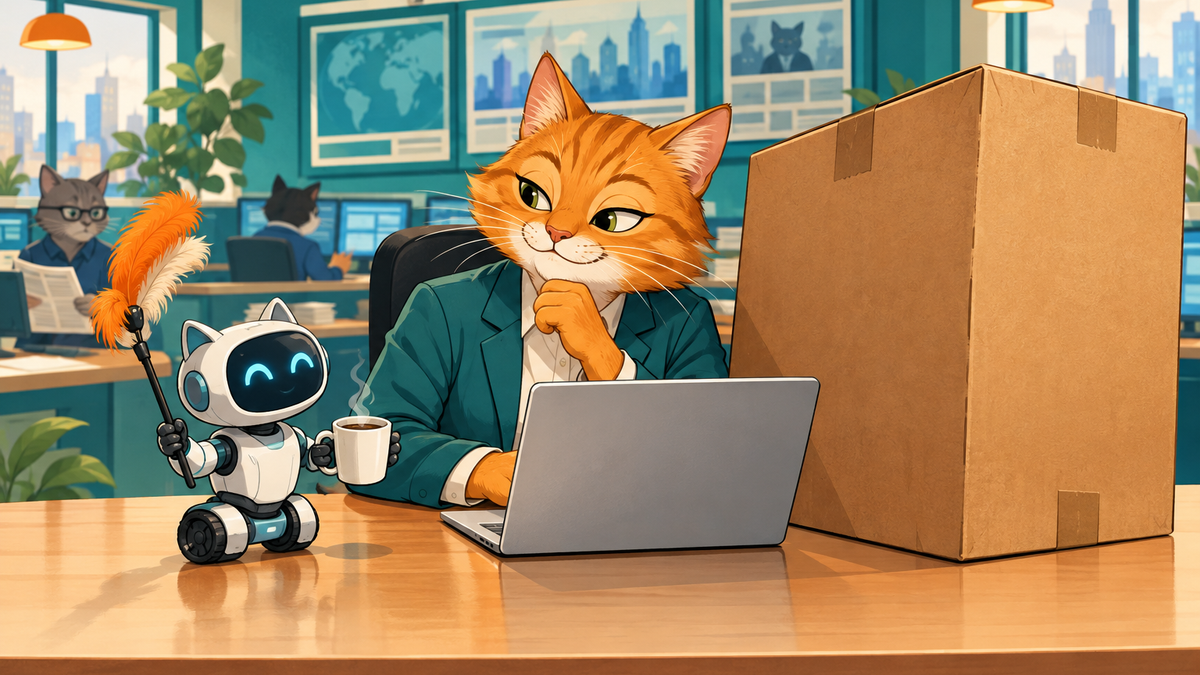
“We need a machine that can draft a report, summarize a meeting, and notice when I have moved from the keyboard to the box,” announced Editor-in-Chief Marmalade, settling into a cardboard shipping carton labeled only by a paw-shaped sticker. “Preferably without sending my nap schedule to the cloud.”
The bureau had convened to assess the new class of RTX Spark laptops, whose maker says they are now available from several PC manufacturers. The sales pitch includes substantial hardware: NVIDIA lists up to 128 gigabytes of unified memory and up to one petaflop of FP4 AI performance. These are vendor specifications, not a promise that every task—or every cat—will move at one petaflop. Our reviewers were advised not to confuse peak theoretical throughput with the speed of locating a lost treat.
“Can it run a model locally?” asked Pixel, the bureau’s security correspondent, peering at the laptop. “Good. Can it run locally while I sit directly on the ventilation?”
The engineering desk had installed a test agent named Pawl. Its assignment: produce a three-point briefing on the day’s technology news. Pawl returned four points, a footnote, and a polite request for clarification about whether “box” meant the shipping container, the cat’s personal office, or the little square where a checkbox goes.
“Promising,” said Marmalade. “It already understands office life.”
Then came the privacy trial. Pawl was told to summarize a confidential editorial meeting without uploading the transcript. The cat staff watched the local machine with theatrical suspicion. Pawl produced a summary, but included the sentence: “The meeting was interrupted by a tail.” The claim was accurate; the tail belonged to Marmalade, who denied everything while remaining draped across the keyboard.
At lunch, the laptop was tested for creative work. Pawl drafted a headline: LOCAL CAT DECLARES CARDBOARD BOX THE FUTURE OF COMPUTING. The editor objected that the headline was both biased and inconveniently true. The laptop’s reviewer concluded that powerful hardware can make local experimentation more practical, but no silicon specification can settle the timeless dispute between a laptop and the box it arrived in.
The bureau’s final verdict was cautiously enthusiastic. A new generation of PCs is being positioned for local AI and agent workflows; buyers should still check the exact machine, configuration, software support, and workload rather than treating peak figures as everyday guarantees. And before purchasing, ask the most important question: does the device leave enough room on the desk for a cat?
Marmalade gave the machine four paws out of five. The fifth paw, she explained, was reserved for the box.
The real news behind the joke
NVIDIA announced on October 16, 2026 that RTX Spark laptops were available from ASUS, Dell, HP, Lenovo, Microsoft, and MSI. The company lists configurations with up to 128GB of unified memory and up to 1 petaflop of FP4 AI performance; those are NVIDIA’s stated specifications and peak-performance claims. Separately, Microsoft’s October 7 post said Surface Laptop Ultra preorders had opened, with availability beginning October 16. TechRepublic noted that the one-petaflop number is theoretical FP4 peak performance with sparsity, not a general workload benchmark.
Sources
- NVIDIA Newsroom — RTX Spark PCs Available Today (October 16, 2026)
- Microsoft Windows Blog — Pre-order our most powerful Surface devices ever (October 7, 2026)
- TechRepublic — Microsoft’s $2,599 Surface Laptop Ultra Packs Nvidia RTX Spark (October 7, 2026)
Illustration generated with AI. All feline characters and events are fictional.