The Household Has Hired a Cat-Calendar Agent. The Cats Have Questions.
Six cats, one shared calendar, and a schedule packed with naps, sunbeams, and unresolved red-dot investigations. A fictional feline take on family AI assistants.
CAT PARODY / SATIRE — The feline characters and events in this story are fictional.
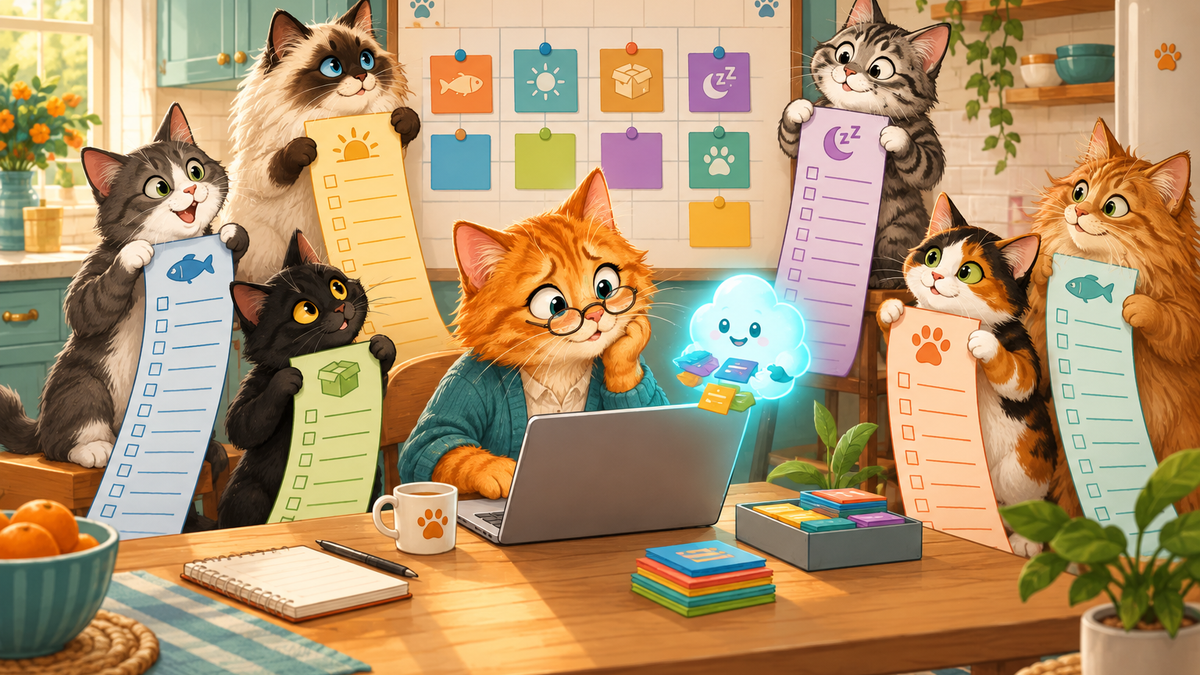
In a development that has caused six cats to gather around one laptop and absolutely nobody to surrender the warm keyboard, the Whisker household has appointed a shared AI assistant to manage its calendar.
The new system, called CC (short for Cat Coordinator, according to no official source whatsoever), promised to bring order to a home where one cat had booked the 10 a.m. sunbeam, another had marked the same cushion as a private nap zone, and a third insisted the weekly fish delivery was “a recurring event of constitutional importance.”
At first, the cats welcomed the arrangement. The orange tabby, acting as household secretary, supplied the assistant with a carefully curated set of facts: breakfast happens early, the hallway is a racetrack, and the cardboard box beside the refrigerator is not to be recycled under any circumstances.
Then came the shared morning briefing.
“Today: 8:00 a.m., inspect the empty food bowl. 8:15 a.m., loudly report that it is empty. 9:00 a.m., sit directly on the document the humans need. 11:30 a.m., simultaneous nap rotation. Reminder: the red dot has not been located.”
“Finally, a system that understands our priorities,” said Miso, who had not read the briefing because she was sitting on the tablet displaying it.
The calendar’s first challenge was scheduling six individual naps without allowing any overlap in premium locations. The sunny windowsill was assigned in 20-minute increments. The laundry basket was classified as “high demand, soft-sided, subject to spontaneous occupation.” A dispute over the top stair was resolved when the assistant created a new category: “shared space, emotionally contested.”
But the real test arrived when the household tried to plan dinner. The assistant asked for everyone’s preferences. One cat selected tuna. Another selected chicken. A third selected “whatever is in the human’s bowl.” The fourth demanded a meal plan while refusing to reveal whether she considered kibble a meal or merely an opening statement.
After several rounds of clarifying questions, CC produced a tidy shopping list and a calendar reminder: “Buy six dinners; expect seven opinions.” The humans were impressed. The cats were suspicious. A shared memory had recorded that Miso liked the blue bowl, which Miso said was “private information from a previous life” and should not be used to infer that she liked the blue bowl today.
By afternoon, the assistant had coordinated a vet reminder, a box-inspection rota, and a carefully permissioned list of which household members could receive updates. It did not, however, resolve who had knocked a pen off the desk. The assistant requested more context. All six cats looked away at once, a response the system has not yet learned to interpret.
At press time, the Whisker household reported improved scheduling and unchanged levels of dramatic sighing. The orange tabby secretary said the technology was “useful, provided it remembers that calendar access is not the same thing as authority over the sunbeam.” The assistant has added that as a household preference.
The real news behind the joke
Google Labs announced an experimental version of CC designed for families and groups. Google says up to six members can choose information to share with the agent, which can create a shared daily brief, track tasks, connect with Google tools, and help with activities such as planning meals or filling forms. The experiment is available to adults in the United States with personal Google accounts. These product details are factual; the cats, dialogue, and household incidents above are invented.
Sources: Google Labs announcement (primary source); TechCrunch coverage; Ars Technica coverage.
Illustration generated with AI.